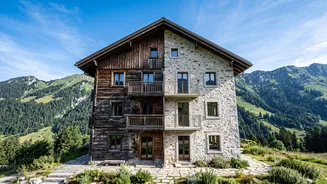







Imagine going to sleep with your head in Switzerland and your feet in France. At the Hotel Arbez Franco-Suisse, nestled in the Jura Mountains, this isn't a dream; it's a booking. This is the story of a hotel born from a border dispute.
A Fortunate Loophole
The tale of the
Hotel Arbez begins with a canny entrepreneur and a quirk of 19th-century diplomacy. In 1862, France and Switzerland decided to redraw their border through the Vallée des Dappes. The new boundary was set to slice the small village of La Cure in two. An important clause in the Treaty of Dappes stated that any existing buildings straddling the new line would be left undisturbed. Before the treaty was ratified in 1863, a local businessman named Ponthus quickly constructed a three-story building precisely on the future border. His foresight was rewarded; he opened a bar on the French side and a grocery store on the Swiss, creating a cross-border business from a single building.
From Shop to Hotel
Ponthus's dual-nation establishment operated for decades before his heirs sold the property in 1921 to Jules-Jean Arbez. It was Arbez who converted the building into the hotel that now bears his family name. Today, the hotel, also known as L'Arbézie, is still run by the Arbez family. The international border, once a source of geopolitical negotiation, is now a celebrated feature. It runs invisibly through the dining room, kitchen, and several guest rooms, creating an experience found nowhere else on earth. The hotel pays taxes to both France and Switzerland, a testament to its truly binational identity.
Sleeping Across Borders
The hotel’s main attraction is, of course, its border-straddling rooms. In the famous honeymoon suite, the bed is split directly down the middle by the border, allowing couples to sleep in two countries at once. In another room, the bedroom is in Switzerland, but the bathroom is in France, requiring a mini-international trip for a midnight visit. Even the main staircase is divided; it begins in France, but by the seventh step, you have crossed into Switzerland. The layout is a constant source of amusement and a tangible connection to the building's strange and wonderful history.
A Haven in History
The hotel's unique position gave it a serious role during times of conflict. During the German occupation of France in World War II, the hotel became a place of refuge. Because Switzerland remained neutral, German soldiers were permitted to enter the French side of the building but were forbidden from crossing into the Swiss portion. Since the stairs to the upper floors began in France but landed in Switzerland, the entire upstairs became inaccessible to them. This provided a safe haven for refugees and French Resistance members, who were sheltered by the Arbez family. Max Arbez, the owner at the time, was later honoured for his role in rescuing those fleeing persecution.
A Place of Diplomacy
The hotel's neutrality also made it an ideal location for sensitive political discussions. In 1962, it was chosen for secret, preliminary negotiations that led to the Évian Accords, which ended the Algerian War and resulted in Algeria's independence. The French delegation could enter from their side, while the Algerian representatives arrived via neutral Switzerland, meeting in a place that belonged to both and neither. This moment cemented the hotel's legacy not just as a curiosity, but as a small, yet significant, player on the world stage.