








A Race Against a Decaying Orbit
The target of this unprecedented mission is the Neil Gehrels Swift Observatory, a prolific NASA space telescope launched in 2004. For over two decades, Swift has been an essential tool for astronomers, specializing in detecting gamma-ray bursts—the most
powerful explosions in the universe. But the observatory is in trouble. Increased solar activity has caused Earth’s upper atmosphere to expand, creating more drag on satellites in low Earth orbit. Swift, which has no propulsion system of its own, has seen its orbit decay much faster than anticipated and was projected to burn up upon re-entry by the end of 2026. With a critical scientific asset at risk, NASA put out an urgent call for a rescue plan.
The Robotic Lifeguard
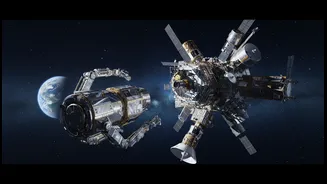
The company that answered the call is Katalyst Space Technologies, an Arizona-based startup. In a feat of rapid engineering, Katalyst designed, built, and tested its robotic servicing spacecraft, named LINK, in less than a year. The mission launched on July 3, 2026, aboard a Northrop Grumman Pegasus XL rocket, which was air-launched from a carrier jet over the Pacific Ocean. The refrigerator-sized LINK spacecraft is now in orbit, undergoing system checks before it begins its careful approach. This mission marks a significant shift for NASA, which turned to a commercial partner for a complex rescue after cancelling a similar in-house project due to cost overruns.
The High-Stakes Handshake in Space
What makes this mission so challenging is that the Swift observatory is an “unprepared” target. Unlike the Hubble Space Telescope, which was designed to be serviced by astronauts, Swift has no docking ports, no grapple fixtures, and no easy way to be grabbed. The LINK spacecraft must perform what is essentially robotic surgery in open space. Using its onboard sensors, including cameras and lidar, LINK will first inspect Swift to identify secure points on its structure that can be safely grabbed. It will then use its three robotic arms to carefully latch onto the observatory without damaging any of its sensitive instruments. It is a delicate, high-stakes maneuver that has never been attempted on a satellite not designed for it.
From a Disposable to a Sustainable Model
While saving Swift is the primary goal, the mission has far broader implications. A success would prove the viability of a new commercial industry: in-orbit servicing, assembly, and manufacturing (ISAM). For decades, satellites have been largely disposable; once they run out of fuel or a component fails, they become expensive pieces of space junk. This mission represents a potential turning point. Companies like Katalyst are developing the technology to inspect, repair, upgrade, and relocate satellites directly in orbit. This could dramatically extend the lifespan of valuable assets, reduce the growing problem of space debris, and create a more sustainable and economically efficient model for space operations.
What Happens Next
As of mid-July 2026, the Katalyst team is methodically commissioning the LINK spacecraft, testing everything from its xenon-fueled propulsion system to its flight controls. The team has already successfully addressed minor issues with communications and attitude control, demonstrating their ability to manage the spacecraft remotely. Once these checkouts are complete, LINK will begin the multi-week process of approaching Swift. After the crucial grappling maneuver, LINK will use its own thrusters to gently boost the combined spacecraft into a higher, stable orbit about 370 miles above Earth. The entire process of raising the orbit is expected to take several months, after which Swift could gain another decade of operational life.