







A New Look at a Volcanic World
For decades, our image of Io has been shaped by its dramatic volcanic plumes and vast lava flows. We knew it was hot, but we assumed the most intense heat was confined to these visible hotspots. Recent data from the Juno mission has turned this idea on its head.
Using its Microwave Radiometer (MWR), a tool originally designed to study Jupiter’s deep atmosphere, scientists have taken the first-ever temperature readings from beneath Io’s crust. The results, published in the Journal of Geophysical Research: Planets, show a significant temperature increase just a few feet below the ground, a gradient far too steep to be explained by sunlight alone. This widespread underground warmth suggests that the moon’s volcanic heart is beating more powerfully and pervasively than its surface suggests.
The Engine of a Fiery Moon
What makes Io a planetary inferno? The answer lies in its relationship with Jupiter. Io is caught in a relentless gravitational tug-of-war. The immense pull from Jupiter, combined with nudges from the neighboring moons Europa and Ganymede, constantly stretches and squeezes Io. This process, known as tidal heating, generates tremendous friction and heat deep within the moon's interior, melting rock into magma. This internal heat output is many times greater than Earth's. For a long time, scientists believed this process powered a global magma ocean just beneath the crust. However, the exact nature of Io's interior has been a topic of debate, with some models suggesting a solid mantle with pockets of molten rock instead of a full-fledged ocean.
How Juno Peered Beneath the Crust
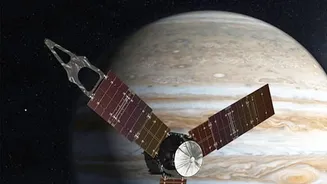
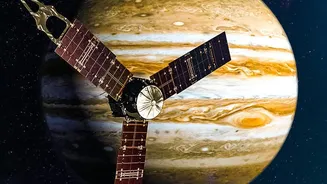
The key to this discovery was using an instrument for a purpose it wasn't originally built for. Juno's Microwave Radiometer (MWR) was designed to pierce through Jupiter's thick cloud cover. During two close flybys of Io in late 2023 and early 2024, the mission team aimed the MWR at the moon's surface, coming within about 1,500 kilometres. This allowed the instrument to detect thermal emissions from depths ranging from a few inches to tens of feet. It was a surprising and successful experiment. Scott Bolton, Juno's principal investigator, noted that the ability to see below a rocky moon's surface was an unexpected discovery with major implications for studying volcanoes, even here on Earth.
What This Widespread Heat Means
The data presents two main possibilities to explain the widespread subsurface heat. The first is that heat could be rising steadily through a conductive crust, like a gentle but persistent warmth radiating from below across the entire moon. The second possibility is that the heat escapes through scattered patches of thin crust located above underground lava tubes or hot vents, covering a significant portion of the surface. Either scenario paints a picture of a world with a much more complex and active plumbing system for its heat than previously thought. The findings also revealed that much of Io's surface is surprisingly smooth and composed of low-density material, possibly like fine volcanic ash or pumice, which is constantly resurfacing the moon and burying older terrain.