


Our New Messenger from Deep Space
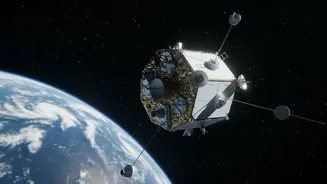
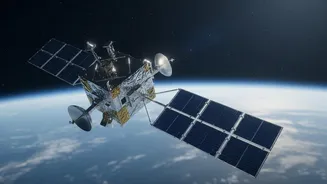
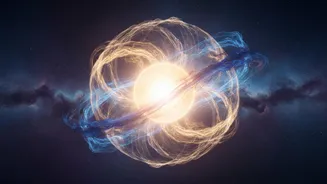
Launched in September 2025, NASA's Interstellar Mapping and Acceleration Probe, or IMAP, is a state-of-the-art celestial cartographer. Its mission is to study the heliosphere—the vast magnetic bubble created by the Sun that shields our entire solar system
from harsh galactic radiation. After a journey of about 1.5 million kilometres, IMAP reached its operational orbit between the Earth and the Sun in January 2026. From this strategic vantage point, known as the first Lagrange point (L1), it gets an uninterrupted view of the Sun's activity. The primary science mission officially began in February 2026, and as of early August, NASA has made the first batch of its scientific data public, marking a major milestone.
Decoding the Sun’s Fiery Breath
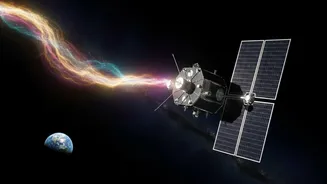
The focus of IMAP's investigation is the solar wind, a relentless stream of charged particles flowing from the Sun at speeds up to 800 kilometres per second. This isn't a gentle breeze; it's a superheated plasma that carries the Sun's magnetic field throughout the solar system. This outflow is what inflates the heliosphere, our protective shield. However, the solar wind is also the primary driver of space weather. When intense bursts of solar wind, known as coronal mass ejections, slam into Earth’s magnetic field, they can trigger geomagnetic storms. These storms are responsible for the beautiful auroras at the poles, but they can also be highly disruptive. They pose a significant threat to our modern, tech-reliant society by potentially damaging satellites, disrupting GPS and communication signals, and even overwhelming power grids on the ground.
First Light: What the New Data Reveals
The first public data release comes from seven of IMAP's ten sophisticated instruments. While it represents just the initial months of a multi-year mission, it's the first step in building an unprecedented, three-dimensional map of the heliosphere's boundaries. This isn't just one picture but a coordinated stream of information. Instruments like SWE and SWAPI are measuring the electrons and ions that form the bulk of the solar wind, while the MAG instrument tracks the interplanetary magnetic field it carries. Others, like CoDICE, are analyzing particles to determine their origin, distinguishing between those from our Sun and those from interstellar space. This initial dataset provides a crucial baseline for scientists, allowing them to calibrate their models and begin the long-term project of understanding how the solar wind is accelerated and how it interacts with the galaxy.
An Early Warning System for Earth
One of IMAP's most practical functions is its role in space weather forecasting. Thanks to its position at L1, the spacecraft intercepts solar wind particles about 30 to 60 minutes before they reach Earth. A portion of its data is streamed back in near-real time through a system called I-ALiRT (IMAP Active Link for Real-Time). This continuous feed gives forecasters a vital heads-up, allowing them to issue warnings for satellite operators, airline companies, and power grid managers. This advance notice is critical for taking protective measures, such as putting satellites into a safe mode or preparing for potential grid fluctuations. As our reliance on space-based technology grows and humanity plans for future missions to the Moon and Mars, this enhanced forecasting capability becomes increasingly essential for safety and security.