





Meet the Celestial Cartographer
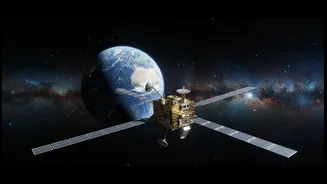
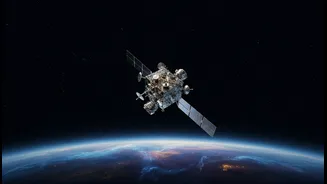
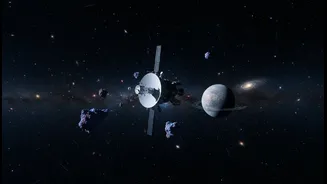
The spacecraft at the heart of this endeavor is the Interstellar Mapping and Acceleration Probe, or IMAP. Launched in late 2025, IMAP is not travelling to the far reaches of the solar system like the famous Voyager probes. Instead, it has journeyed to a gravitationally
stable point about 1.5 million kilometres from Earth, known as Lagrange point 1 (L1). From this unique vantage point, it can continuously observe particles streaming towards us from the Sun and from the boundary of our solar system. After arriving at its orbital post in early 2026, IMAP began its primary science mission: to act as a celestial cartographer, creating the first-ever comprehensive 3D map of our solar system's protective bubble.
Our Solar System’s Invisible Shield
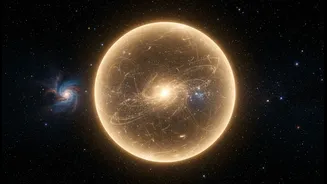
The shield IMAP is studying is called the heliosphere. It’s an enormous bubble blown into space by the solar wind, a constant stream of charged particles flowing from the Sun. This bubble extends far beyond Pluto, enveloping all the planets and creating a distinct boundary between our solar system and the interstellar medium—the space between stars. Think of it as our own cosmic coastline, where the Sun’s influence finally gives way to the vast expanse of the Milky Way galaxy. Without this protective sphere, life on Earth would be exposed to a much harsher environment. The heliosphere acts as a vital shield, deflecting a majority of the high-energy particles that constantly bombard our system from galactic sources.
The Danger of Cosmic Rays
The threat the heliosphere mitigates is galactic cosmic radiation (GCR). These are not rays in the traditional sense, but atomic nuclei—remnants of ancient supernovae—that have been stripped of their electrons and accelerated to nearly the speed of light. They are tiny, energetic bullets that can damage living cells and electronic equipment. On Earth, we are doubly protected by both the heliosphere and our planet’s magnetic field and atmosphere. But for astronauts on long-duration missions to the Moon or Mars, and for sensitive spacecraft, GCR poses a significant risk, increasing the danger of cancer and other degenerative diseases. Even the hardy Voyager probes, which have passed beyond the heliosphere, are now constantly 'dodging bullets' in this hostile environment.
How IMAP Maps the Boundary
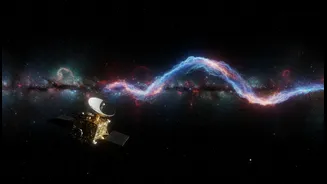
IMAP won't fly to the boundary itself, which is billions of kilometres away. Instead, it uses a suite of ten sophisticated instruments to intercept and analyze 'messengers' from the edge. When particles from the solar wind travel to the heliosphere’s edge, they collide with neutral atoms from interstellar space. Some of these particles are bounced back toward the Sun as energetic neutral atoms (ENAs). These ENAs travel in straight lines, unaffected by magnetic fields, carrying information about where they came from. By collecting these particles, IMAP can piece together a map of the boundary’s structure and dynamics, revealing its size, shape, and how it interacts with the galaxy around it.
Forecasting Weather in Space
Beyond its primary mission of mapping the galaxy's edge, IMAP serves a crucial, practical purpose: improving space weather forecasting. From its post at L1, the probe gets a direct view of the solar wind and energetic particles heading toward Earth. This data is broadcast in near real-time, giving forecasters advance warning of solar storms that could disrupt satellites, power grids, and endanger astronauts. The Voyager probes were pioneers that first touched interstellar space, but IMAP represents the next leap forward. It's a dedicated observatory that will not only help us understand our cosmic shield but also provide a vital early-warning system to protect our technology and future explorers as we venture further from home.