








A Flawless Launch
In the early hours of September 4, 2026, ISRO's mighty Geosynchronous Satellite Launch Vehicle (GSLV-F17) thundered into the dark skies from the Satish Dhawan Space Centre in Sriharikota. The 51.7-metre-tall rocket performed flawlessly, and about 18 minutes
after liftoff, it precisely placed its precious cargo, the 2,367 kg EOS-05 satellite, into a sub-geosynchronous transfer orbit. This was the 19th flight for the GSLV and a significant achievement, as EOS-05 is the heaviest satellite the rocket has carried to such an orbit to date. The success was a welcome boost, marking ISRO's first triumphant orbital mission of the year.
The 'Naughty Boy' Delivers
The GSLV is a three-stage heavy-lift rocket designed to place large satellites into geosynchronous orbit, about 36,000 km above Earth. Its most critical component is the indigenously developed cryogenic upper stage, which uses super-cooled liquid hydrogen and liquid oxygen as propellants. Mastering this complex technology was a huge challenge, and the rocket earned the nickname "naughty boy" after a few early failures. However, this successful launch of the GSLV-F17 further proves the vehicle's reliability and ISRO’s mastery over the complex cryogenic technology, cementing its role as the workhorse for India's most ambitious space missions.
An Unblinking Eye on India
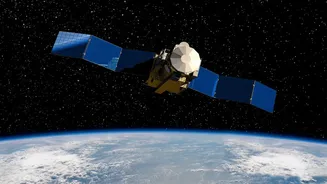
EOS-05 is not just another satellite; it's a state-of-the-art Earth observation satellite and India's first to operate from a geosynchronous orbit. Unlike most other observation satellites that are in low-Earth orbit and can only view a specific location when they pass over it, EOS-05 will orbit at the same speed as the Earth's rotation. This allows it to seemingly 'hover' over the Indian subcontinent, providing a continuous, near real-time watch. Over the next few days, ISRO will perform a series of complex orbit-raising manoeuvres to move the satellite from its current transfer orbit to its final destination 36,000 km above the surface.
Why This Mission is a Game-Changer
The capabilities of EOS-05 have far-reaching implications. For disaster management, it will be a crucial tool, allowing authorities to monitor the rapid development of cyclones, floods, and forest fires with imagery captured as frequently as every five minutes. This persistent view will also greatly benefit agriculture by monitoring crop health and land use, and aid in weather forecasting. Furthermore, the satellite has significant strategic importance. The ability to continuously monitor the Indian landmass and its surrounding maritime zones provides a major boost to the nation's security and surveillance capabilities, helping keep an eye on borders and avert potential incursions.