

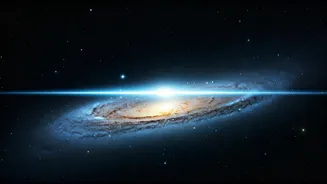



Our Galaxy's Mysterious Heart
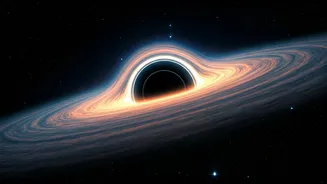
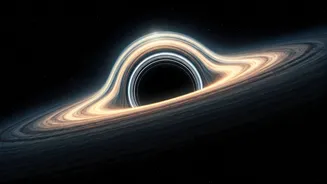
Sagittarius A, often abbreviated as Sgr A, is a gravitational titan located about 27,000 light-years from Earth. It has a mass more than four million times that of our Sun, all packed into an incredibly dense point. While we can't see the black hole itself—its
gravity is so strong that not even light can escape—we can observe the super-heated gas and dust swirling around it in a brilliant, chaotic dance. This material forms a glowing ring around the black hole’s event horizon, the point of no return. For decades, astronomers have studied this region to understand how black holes feed and how they influence the galaxies they inhabit. Yet, the turbulent and fast-changing nature of the material around Sgr A has made it a particularly difficult subject to study in detail.
A Telescope the Size of Earth
To get a clear look at Sgr A, scientists needed a telescope with unprecedented power. The solution was the Event Horizon Telescope (EHT), a global network of radio observatories that work together as a single, planet-sized virtual dish. A key player in this network is the Atacama Large Millimeter/submillimeter Array (ALMA) in Chile. Perched high in the arid Andes mountains, ALMA's 66 high-precision antennas are exceptionally sensitive to the faint millimeter-wavelength light that emanates from the edge of the black hole. By combining ALMA's data with that of other telescopes around the world, the EHT collaboration can achieve a resolution sharp enough to see an orange on the surface of the Moon. This extraordinary capability was essential for the latest breakthrough.
Unveiling the Magnetic Secret
The "hidden action" that ALMA and the EHT have now revealed is a powerful and surprisingly organized magnetic field spiraling around the edge of Sgr A. Astronomers achieved this by imaging the black hole in polarized light for the first time. Think of polarized light as light waves that are all wiggling in the same direction, like organized ripples on a pond. As light travels from the hot gas near the black hole, it gets polarized by the magnetic fields it passes through. By mapping this polarization, scientists could directly infer the structure of these otherwise invisible magnetic fields. The new image shows these fields are not a tangled mess, as might be expected, but are arranged in a strong, spiraling structure—a major clue to the engine powering our galaxy's central giant.
A Black Hole's Powerful Engine
These magnetic fields are the key to understanding how Sgr A interacts with its surroundings. They act as a cosmic traffic controller, governing the flow of gas and dust that the black hole feeds on. The structure's strength and organization suggest that it can resist the turbulence of the inflowing material, channeling it in a specific way. Even more exciting is the hint that these fields could be strong enough to launch a jet of high-energy particles, even if we don't see one currently. Some scientists speculate that Sgr A may have a dormant or "frustrated" jet that has been active in the past and could be again. This finding suggests that even our relatively quiet black hole possesses the same fundamental machinery as the most active black holes in the universe.
The Bigger Picture: A Universal Blueprint?
Perhaps the most significant part of this discovery is how similar Sgr A's magnetic field structure is to that of M87, the first black hole ever imaged. This is startling because the two objects are vastly different. M87 is a behemoth over 1,000 times more massive than Sgr A and fires off a colossal jet that extends for thousands of light-years. Scientists expected their environments to be just as different. The fact that their magnetic field structures are nearly identical suggests a universal mechanism at play. It implies that having strong, organized magnetic fields might be a common trait for all supermassive black holes, regardless of their size or activity level. This provides a crucial new framework for understanding how these cosmic giants grow and shape the evolution of their host galaxies.