
The Cosmic Riddle
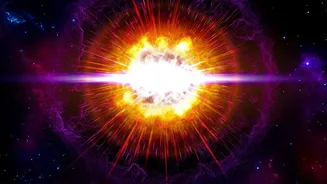
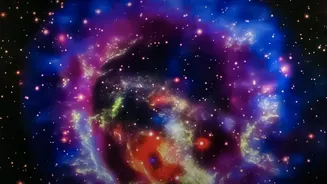
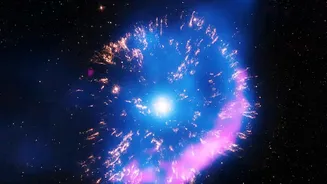
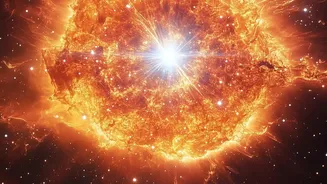
When a star many times more massive than our sun runs out of fuel, its core collapses under its own immense gravity. This triggers a cataclysmic event that can briefly outshine an entire galaxy: a supernova. For a long time, there has been a persistent
problem in astrophysics. When scientists ran computer simulations of this process based on the known laws of physics, the star often just... fizzled. The simulated shockwave from the collapsing core wasn't strong enough to blow the star apart. It would stall, and the star would fail to explode. This discrepancy, known as the core-collapse supernova problem, meant a crucial piece of the puzzle was missing. Scientists knew something had to reignite that stalled shockwave to create the magnificent explosions we observe across the cosmos.
Enter the Ghost Particle
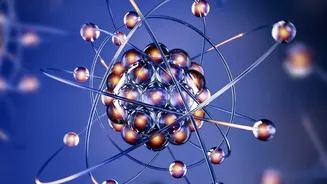
The missing piece, scientists have long suspected, is the neutrino. A neutrino is a fundamental particle so small and so weakly interactive that trillions of them pass through your body every second without you noticing. They are often called 'ghost particles' because they barely interact with other matter. During a star's core collapse, an almost unimaginable number of neutrinos are created, carrying away about 99% of the total energy of the explosion. The long-held theory was that even though neutrinos rarely interact, this sheer number means that a small fraction of them would be absorbed by the material just outside the core. This injection of energy, a process called neutrino heating, could be enough to re-energize the shockwave and blow the star to smithereens.
Simulating the Impossible
The problem is that simulating this process is incredibly complex. It's not just a simple explosion; it involves multi-dimensional fluid dynamics, extreme physics, and the bizarre quantum behaviour of neutrinos. Early, one-dimensional models couldn't capture the turbulent, messy reality inside a dying star. Now, thanks to supercomputing power, new and incredibly detailed three-dimensional simulations are possible. Recent work, particularly from researchers at the University of Copenhagen, has taken this a step further by incorporating a subtle but critical aspect of neutrino behaviour: their ability to change 'flavour'. Neutrinos come in three types, and they can switch between these types as they travel. It was previously thought this had little effect, but new simulations show this is a game-changer.
Flavor, Fate, and Black Holes
The latest simulations, published in September 2026, have found that these neutrino 'flavour conversions' can dramatically alter the outcome for a dying star. By modelling hundreds of stellar collapses, researchers found that including flavour changes could decide whether a star explodes or not. For stars in a specific mass range—about 16 to 30 times the mass of the Sun—many that were expected to explode in older simulations now failed, collapsing directly into black holes. A small change in how neutrinos behave determines the fate of the entire star. This surprising discovery might help solve several cosmic mysteries, such as why astronomers have observed fewer supernovas than theories predicted, and why some giant stars seem to vanish without a trace—they may be collapsing quietly into black holes, a fate dictated by neutrinos.