








A Veteran Hand at the Helm
Colette Kress is no stranger to Nvidia's inner workings. As the company’s executive vice president and chief financial officer since 2013, she has been a central figure in its transformation from a niche gaming chip designer to a dominant force in artificial
intelligence. During her tenure, Kress has overseen the company's finances through a period of explosive growth, with revenue soaring from just over $4 billion in the fiscal year she joined to more than $200 billion in fiscal 2026. Prior to Nvidia, she built a formidable resume with senior finance roles at other tech giants, including Microsoft and Cisco. Those who have worked with her describe her as a pragmatic and calming influence, a contrast to the famously ambitious and visionary style of her predecessor. Her deep operational knowledge and credibility with investors made her a logical choice to provide stability and reassure markets during the transition.
The Search for a Permanent Leader
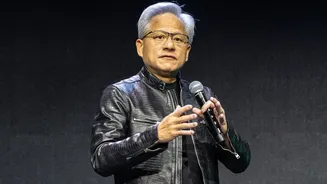
The board's task of finding a permanent CEO is a monumental one. The transition follows the abrupt resignation of co-founder Jensen Huang, who led the company for over 30 years. The departure of such a visionary figure has naturally created uncertainty. The board has announced it is conducting a comprehensive search, considering both internal and external candidates, and has retained an executive search firm to assist. While Kress is at the helm for now, other long-serving executives are also seen as potential internal candidates. The key challenge for the board is to find a leader who can not only maintain Nvidia's aggressive pace of innovation but also navigate the increasing complexities of the global semiconductor industry. The new CEO will need to blend deep technological understanding with strategic foresight and the ability to manage a company that has become central to the global economy.
Continuity in the AI Revolution
Despite the change in the CEO's office, Nvidia's core mission remains firmly in place. The company has been quick to assert that its ambitious AI roadmap is not in question. This strategy is the engine of Nvidia's success, built on the concept of 'AI factories'—powerful data centers that function as revenue-generating assets. The roadmap involves a relentless, near-annual cadence of new product releases, from next-generation GPUs like the upcoming Rubin platform to the networking and software ecosystems like CUDA that create a powerful, integrated platform. This full-stack approach, providing everything from silicon to software, is designed to make Nvidia's technology indispensable to its partners and customers, from hyperscale cloud providers to enterprise developers. By focusing on being the foundational infrastructure provider, Nvidia enables a vast ecosystem of partners to build AI applications without directly competing with them.
Market Reaction and Path Forward
A sudden CEO departure, especially of a founding figure, inevitably rattles investors, and Nvidia's stock saw an initial dip following the news. Such transitions can introduce risks, including concerns about talent retention and execution. In her first company-wide meeting as interim CEO, Kress moved to reassure employees, promising accelerated pay raises and equity awards to maintain workforce stability. Her immediate focus has been to project confidence and continuity. For Wall Street, the focus is twofold: ensuring the operational execution of the existing AI roadmap continues without interruption and seeing a clear, decisive process for selecting a permanent leader who can carry the company into its next phase. While Kress’s appointment has been seen as a stabilizing move, the market will be watching the board's next steps closely for signs of the company's long-term strategic direction.