




A Star's Violent Demise
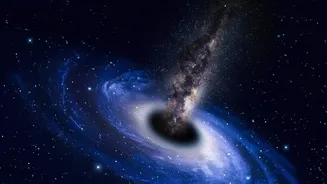
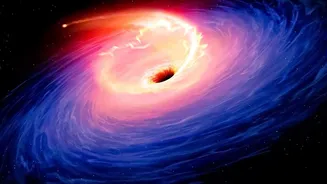
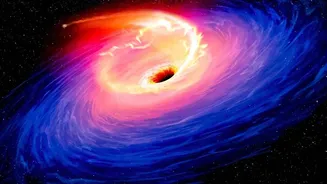
In the immense quiet of space, one of the most violent events imaginable unfolds when a star wanders too close to a supermassive black hole. The black hole's colossal gravity creates an extreme tidal force, overwhelming the star's own gravity that holds
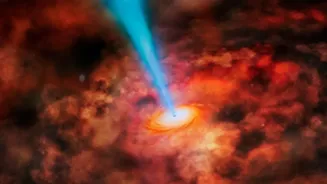
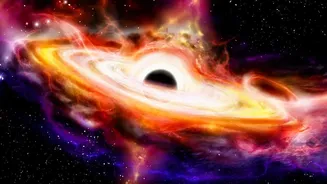
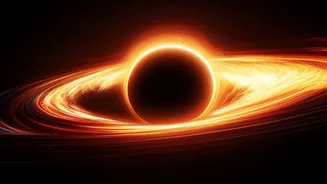
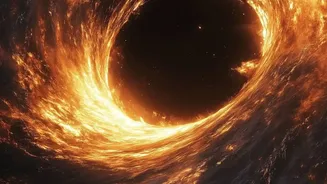
it together. This cosmic tug-of-war stretches the star vertically while squeezing it horizontally, a process gruesomely nicknamed 'spaghettification'. The star is pulled apart into a long stream of gas. While some of this material is flung back out into space, the rest forms a swirling, superheated disk around the black hole. This process, called a Tidal Disruption Event (TDE), releases a brilliant flare of energy that can outshine an entire galaxy for months.
The Cosmic Crime Scene Investigators
Since black holes themselves are invisible, astronomers hunt for them by observing their effects on their surroundings. A TDE is like a cosmic flare lighting up a dark room, momentarily revealing the presence of a dormant black hole. Observatories like NASA's Neil Gehrels Swift Observatory are perfectly suited for this work. Originally designed to hunt for gamma-ray bursts, Swift's ability to quickly slew and observe in multiple wavelengths—from ultraviolet to X-ray—makes it an ideal tool for spotting the tell-tale, multi-stage glow of a TDE. A recent discovery began in November 2025 when a survey at the Palomar Observatory spotted an unusual burst of light about 750 million light-years away. Follow-up observations, including those from Swift, confirmed it was the signature of a star being devoured.
A Black Hole Off the Map
For decades, astronomers assumed these destructive events happened almost exclusively at the centers of large galaxies, because that’s where supermassive black holes are thought to reside. But this latest discovery, and a handful like it, have thrown a wrench in that theory. The TDE was spotted more than 30,000 light-years away from the core of its apparent host galaxy, WISEA J014656.04-152214.7. Finding such a massive black hole, estimated to be a million times the mass of our sun, so far out in the galactic suburbs is unprecedented and forces a major rethink. It wasn't in the city center; it was a hungry giant wandering the cosmic countryside.
Rewriting the Rules of Galaxy Evolution
The existence of these 'wandering' or 'orphan' black holes has long been theorized but rarely observed. Their discovery has profound implications. How did they get there? One leading theory is that they are relics of past galactic mergers. When two galaxies collide, their central black holes may engage in a complex gravitational dance. The lighter of the two can be ejected and sent careening through the new, larger galaxy. Another possibility is that we are witnessing the central black hole of a smaller, dwarf galaxy that has been stripped of its stars as it merges with a larger one. Each TDE found in an unexpected location provides a crucial clue, helping astronomers piece together the violent and dynamic history of how galaxies are built over billions of years.
A New Way to Find the Invisible
This off-center discovery is more than just a cosmic oddity; it validates a whole new method for hunting the universe's most elusive objects. Since these wandering black holes are otherwise dark and invisible, looking for the bright, temporary flare of a TDE is the only way to confirm their existence. As Robert Stein, a NASA research fellow, noted, this technique allows scientists to find otherwise invisible supermassive black holes. With new powerful survey telescopes and artificial intelligence algorithms trained to spot these specific flare signatures, astronomers are now poised to create a more accurate census of these galactic nomads.