






A Tradition Steeped in History
The practice of offering this sacred sweet at the Venkateswara Temple began on August 2, 1715. What started over three centuries ago has evolved into one of the most recognised religious offerings in the world. Initially, a different sweet known as 'Manoharam'
was offered. The laddu as we know it today, a perfect, spherical blend of ingredients, took its current form around 1940, standardised to ensure longevity and ease of distribution to the ever-growing number of pilgrims. This evolution reflects a commitment to providing every devotee with a cherished part of the Tirumala experience.
The Sacred Blueprint: Dittam
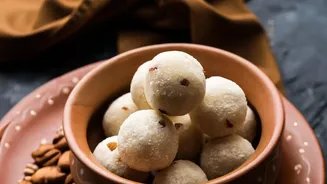
The secret to the laddu's unwavering consistency lies in a meticulously defined recipe known as the 'Dittam'. This sacred blueprint specifies the exact ingredients and, crucially, their proportions. The core components are simple yet must be of the highest quality: pure ghee, Bengal gram flour (besan), sugar, cashews, raisins, cardamom, and sugar candy. While the precise ratios are a guarded secret of the Tirumala Tirupati Devasthanams (TTD), the Dittam has been modified only a handful of times in its long history, always with the goal of meeting rising demand without compromising the sacred taste and quality.
A Kitchen of Unprecedented Scale
The laddu-making process takes place in a massive, dedicated kitchen within the temple complex, known as the 'Potu'. This is no ordinary kitchen; it is a marvel of logistics, blending ancient tradition with modern efficiency. On an average day, the Potu consumes staggering quantities of ingredients: roughly 10 tonnes of gram flour, 10 tonnes of sugar, and hundreds of kilograms of cashews, raisins, and cardamom. A workforce of over 600 people, including 270 skilled cooks called 'pachakas', works tirelessly. To manage this immense scale, the TTD employs a hybrid system where modern equipment, like conveyor belts for transporting ingredients and finished laddus, supports the irreplaceable human skill of the cooks who shape each laddu by hand.
Guarding a Divine Legacy
The consistency of the Tirupati Laddu is not just a matter of pride; it is a protected legacy. In 2009, the laddu was granted a Geographical Indication (GI) tag. This is a significant legal protection, meaning that the name 'Tirupati Laddu' can only be used for the sweets made in the temple's kitchen according to the official Dittam. The GI tag was sought to prevent counterfeit laddus from being sold, protecting devotees from fraud and ensuring the spiritual and physical purity of the prasadam. This legal status underscores that the laddu is not merely a food item but an authentic, geographically specific cultural and religious icon whose integrity must be preserved at all costs.