



The Challenge of Finding Your Way
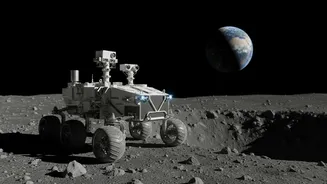
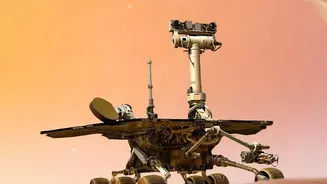
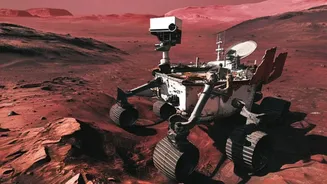
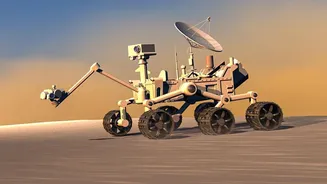
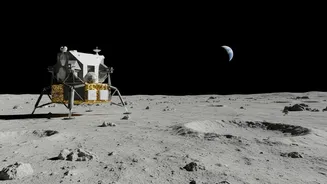
For decades, navigating on the Moon has been a complex, Earth-dependent process. Without a magnetic field to use a compass and no satellite network to ping, rovers have relied on a method called dead reckoning. This involves using gyroscopes for direction
and counting wheel rotations for distance, with a computer constantly calculating the rover's position relative to its starting point—usually the lander. While ingenious, this system is prone to accumulating errors. To correct this, missions require constant support from Earth-based assets like the Deep Space Network (DSN) to provide precise location updates. This reliance creates a significant bottleneck. The DSN is over-subscribed, and communication delays mean rovers can't make quick, autonomous decisions, limiting the scope and speed of exploration.
A GPS for the Moon
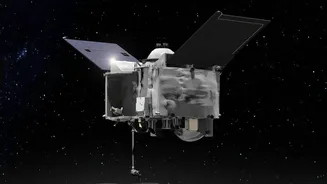
NASA's answer is a new class of technology known as a lunar navigation payload. Recent developments include payloads like the Lunar Node-1 (LN-1) and the Lunar GNSS Receiver Experiment (LuGRE), which aim to create a positioning, navigation, and timing (PNT) network for the Moon. The core idea is to allow spacecraft, rovers, and even astronauts to determine their own location precisely and autonomously, much like we use GPS on Earth. One key technology demonstration, NavCube3-mini, is a compact receiver about half the size of a shoebox. This device is designed to detect the faint signals from Earth's existing GPS and European Galileo satellite constellations, even at lunar distances. By locking onto these signals, a rover or orbiter can calculate its position in real time without having to phone home.
How It Builds a Network
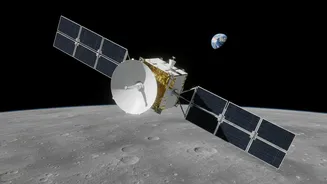
These payloads are designed to work in two ways. Firstly, they can use signals from Earth's navigation satellites. Experiments like LuGRE have already proven this concept is feasible. Secondly, technology like the Lunar Node-1 (LN-1) acts as a surface beacon, or a sort of lunar lighthouse. By placing these beacons on landers and other stationary infrastructure, a local navigation network can be established. Rovers and other assets can then use signals from these fixed points to triangulate their position with high accuracy. This is part of a larger concept called LunaNet, which aims to create an internet and navigation network for the Moon, combining Earth-based signals with a web of lunar relay satellites and surface beacons.
Unlocking a New Era of Exploration
The ability for a rover to know its precise location independently is a revolutionary step. It enables true autonomy. Rovers could embark on long-range scientific traverses over multiple days, far from their landing site, without constant human oversight. More importantly, it unlocks access to some of the most scientifically interesting—and dangerous—locations on the Moon. This includes permanently shadowed craters at the lunar poles, which are thought to contain water ice but are impossible to explore with Earth-dependent communication because there is no direct line of sight. Autonomous navigation would allow a rover to enter a crater, collect data, and navigate its way out safely. It also enables more complex, coordinated missions, where multiple rovers could work together on a single task, a critical capability for future construction and resource prospecting.
Beyond Rovers: An Infrastructure for Commerce
This technology extends far beyond robotic exploration. A reliable navigation network is a foundational piece of infrastructure for a sustainable lunar economy. Landers will use it for precision landings, and future lunar relay satellites will provide continuous coverage, especially around the challenging lunar South Pole. For Artemis astronauts, it means having a reliable way to navigate during extravehicular activities (EVAs), ensuring they always know their position relative to their habitat or rover. As commercial and international missions to the Moon increase, a shared, standardized navigation system will be crucial for safety, coordination, and efficiency. By investing in these payloads now, NASA is not just building a tool for its own missions; it's laying the groundwork for a future where science and commerce can thrive on the lunar surface.