


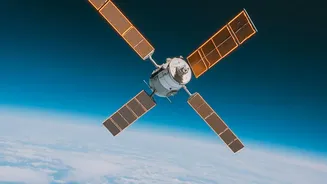
A Sky Full of Satellites
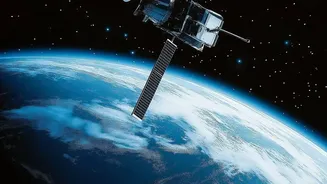
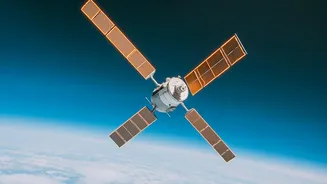
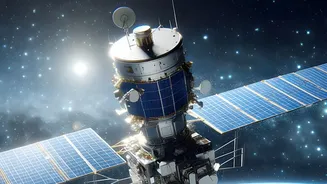
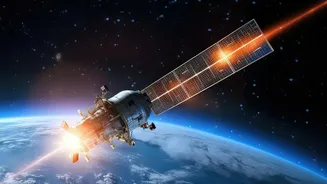
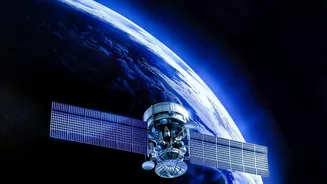
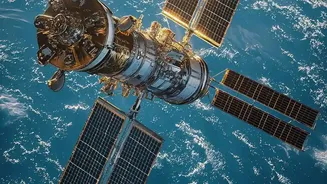
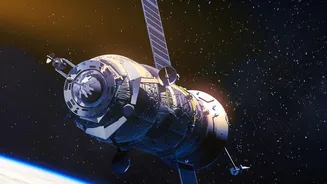
Just over a decade ago, in the early 2010s, there were about 1,000 active satellites orbiting Earth. As of late 2026, that number has skyrocketed to over 16,800. This isn't just a gradual increase; it's an explosion. The primary driver is the advent of commercial
'mega-constellations' in Low Earth Orbit (LEO), the region of space up to 2,000 kilometres in altitude. The European Space Agency (ESA) now launches around ten new payloads daily, while on average, more than three defunct satellites or rocket bodies re-enter the atmosphere every day. This rapid proliferation has fundamentally changed the nature of space operations.
The Rise of Mega-Constellations
The main force behind this orbital boom is the private sector's race to provide global satellite internet. Companies like SpaceX's Starlink, Eutelsat's OneWeb, and Amazon's Project Kuiper are launching satellites by the dozen. Starlink alone operates over 11,000 active satellites, accounting for nearly two-thirds of all active satellites in orbit. China is also rapidly expanding its own constellations, Guowang and Qianfan. While these networks promise to connect the unconnected, they have created unprecedented traffic density. Certain orbital altitudes are now packed at a level with no historical equivalent, turning a once-quiet frontier into a bustling industrial zone.
Dodging Cosmic Bullets
With so many objects whizzing around at speeds of nearly 28,000 km/h, the risk of collision is a constant threat. A collision avoidance manoeuvre is essentially when a satellite fires its thrusters to alter its path and dodge another satellite or piece of debris. A decade ago, these were relatively rare events. Today, they are routine. For example, in the six months leading up to May 2026, Starlink satellites performed over 207,000 avoidance manoeuvres, a sharp increase from the period before. On average, each Starlink satellite now has to manoeuvre almost weekly. For operators, this is becoming a major part of the job, consuming fuel, time, and resources that could otherwise be used for the satellite's primary mission.
The Menace of Space Junk
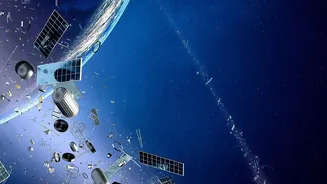
It’s not just active satellites that pose a risk. The orbital environment is littered with 'space junk'—defunct satellites, spent rocket stages, and millions of fragments from past explosions or collisions. There are over 34,000 tracked objects in orbit, but this only includes items larger than about 10 cm. The ESA estimates there are over a million pieces of debris between 1 and 10 cm, each capable of catastrophically destroying a functional satellite on impact. This raises the spectre of the Kessler Syndrome, a theoretical scenario where the density of objects becomes so high that collisions create a cascading chain reaction of debris, potentially rendering certain orbits unusable for generations.
Who Directs the Traffic?
Currently, there is no global air traffic control system for space. Instead, operators rely on data primarily from the U.S. Space Force and other agencies like the ESA to track potential conjunctions. However, as traffic grows, this manual, decentralised system is becoming untenable. This has prompted nations to enhance their own capabilities. India's ISRO, for instance, is developing Project NETRA (Network for Space Object Tracking and Analysis), an early warning system to independently track debris and protect its more than 50 critical satellites. The goal is to gain self-reliance in Space Situational Awareness (SSA) and ensure the safety of vital national assets used for communication, navigation, and security. The ESA is also working on automated, AI-driven collision avoidance systems to handle the sheer volume of alerts.