







A Moon With a Secret
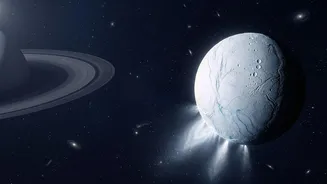
Enceladus, a small, ice-covered moon orbiting Saturn, has long captivated astrobiologists. Though its surface is frozen solid, data from NASA's Cassini mission revealed that a vast, global ocean of liquid saltwater lies beneath the icy shell. More excitingly,
the spacecraft observed giant plumes of water vapor and ice grains erupting from cracks near the moon's south pole, effectively spraying samples of this hidden ocean into space. Analysis of these plumes showed the water contains salts, organic molecules, and molecular hydrogen — key ingredients that could support life. This makes Enceladus one of the most compelling places to look for extraterrestrial organisms in our solar system.
Recreating an Alien Ocean in the Lab
While the presence of water and organic chemicals is promising, the specific conditions of Enceladus's ocean are extreme. The water is thought to be highly alkaline, with a pH as high as 10 or 11, similar to some household cleaners. It is also believed to have very little oxygen or free carbon dioxide, which would pose a major challenge for many forms of life as we know them. To test the limits of life, a team of researchers led by scientists at Ludwig-Maximilians-Universität in Munich decided to recreate these harsh conditions. They created an 'Enceladus simulant' in the lab: an oxygen-poor mixture containing water, salts, minerals, and carbonate to mimic the moon's highly alkaline seafloor environment.
Life Finds a Way
Into this simulated alien ocean, the scientists introduced an Earthly microbe called Methanothermococcus okinawensis. This single-celled organism, a type of archaea, was originally found near deep-sea hydrothermal vents in the waters off Japan. It thrives without sunlight or oxygen, instead getting energy by converting hydrogen and carbon dioxide into methane. In a conventional lab setting, the microbe couldn't grow at the extreme alkaline pH levels tested. But in the Enceladus simulant, it not only survived but continued to grow and produce methane. The microbe adapted its metabolism to scavenge the scarce carbon dioxide, fueled by hydrogen produced from the reactions between the water and powdered rock in the mixture. The surprising result shows that the unique geochemistry of Enceladus might actually help organisms overcome barriers previously thought to be insurmountable.
What This Means for the Search for Life
It's crucial to note that this experiment does not prove life exists on Enceladus. What it does show is that a known type of metabolism—one of the most ancient on Earth—is viable under the moon's strange conditions. It removes a significant barrier and strengthens the scientific case that Enceladus is habitable, at least for some forms of life. This finding, along with a companion study suggesting that Enceladus's plumes may naturally concentrate biological material into ice grains, makes the prospect of finding biosignatures more feasible for future missions. Space agencies are already planning their return. NASA has prioritized a mission called the Enceladus Orbilander, which could launch in the late 2030s to orbit the moon, sample its plumes, and eventually land. The European Space Agency (ESA) is also planning a flagship mission to Enceladus, potentially launching in the early 2040s.