






A Fading Whisper from Deep Space
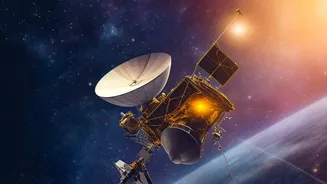
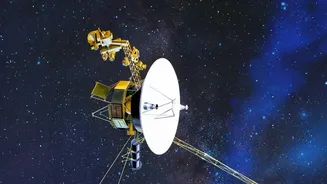
Launched in 1977, Voyager 2 is now over 21 billion kilometres from Earth, drifting through the unexplored territory between stars. For decades, it has been powered by Radioisotope Thermoelectric Generators (RTGs), which convert heat from decaying plutonium
into electricity. But that power source is finite. Each year, the system's output drops by about four watts, forcing mission engineers at NASA's Jet Propulsion Laboratory (JPL) into a delicate balancing act. To keep its scientific instruments alive, they have been slowly turning off non-essential systems, but the power margins have become razor-thin. Without intervention, another of its few remaining science instruments was scheduled to be powered down permanently before the end of 2026.
The 'Big Bang' Solution
Engineers at JPL developed an ingenious plan, nicknamed the “Big Bang,” to free up precious watts. This wasn't a single fix, but a carefully choreographed shutdown and swap. The procedure involved simultaneously turning off certain powered devices and substituting them with lower-power alternatives. A key part of the challenge was ensuring the spacecraft, operating in the absolute cold of interstellar space, remained warm enough to function. By finding a new configuration that consumed less electricity while still generating sufficient residual heat, the team managed to claw back enough power to keep all currently active science instruments running.
An Unprecedented Long-Distance Repair
Fixing a spacecraft that is nearly 50 years old is hard enough; doing it from billions of kilometres away is a monumental challenge. Each command sent to Voyager 2 takes nearly 20 hours to arrive, and another 20 hours pass before engineers on Earth can receive confirmation that the command was executed successfully. This two-day conversation with a machine built in the 1970s requires immense precision and patience. The successful reconfiguration is a testament to the ingenuity of the JPL team and the robust design of the Voyager probes, which were built with technology that predates the personal computer.
What Another Year Buys Humanity
This power-saving manoeuvre is expected to keep Voyager 2's three remaining primary science instruments operating together for at least one additional year. These instruments—a magnetometer, a plasma wave subsystem, and a cosmic ray subsystem—are our only direct source of data from the interstellar medium. They measure the magnetic fields, particles, and plasma waves in the void between stars, providing an unparalleled look at the environment outside our sun's protective bubble, the heliosphere. Every extra day of data adds to a unique, irreplaceable record of humanity's first steps into the galaxy. The same “Big Bang” procedure is now planned for its twin, the even more distant Voyager 1.
The Enduring Legacy of a Grand Tour
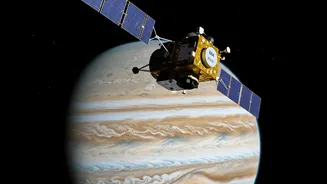
The Voyager missions were originally designed for a five-year “Grand Tour” of the outer planets. Their success was so profound that they have continued operating for nearly half a century, long after completing their initial objectives. They have transformed our understanding of Jupiter, Saturn, Uranus, and Neptune, and have since become humanity's first interstellar explorers. Onboard each spacecraft is a Golden Record, a time capsule of sounds and images from Earth, intended for any intelligent extraterrestrial life that might one day encounter them. As they drift silently onward, the probes are more than just scientific instruments; they are ambassadors of human curiosity.