



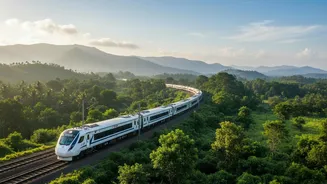
A Journey of Extremes
The proposed Vande Bharat service between Karnataka's tech capital and its coastal hub is one of the most eagerly awaited railway projects in the region. It promises to connect the two cities in roughly six to seven hours, a significant improvement over
the nine to ten hours taken by current express trains. However, the path between them isn't a straight, flat line. It cuts directly through the Western Ghats, featuring one of Indian Railways' most technically demanding stretches: the Sakleshpur-Subrahmanya Road ghat section.
The Ghat Section Challenge
This 55-kilometre stretch is an engineering marvel and a logistical nightmare rolled into one. It features a steep gradient of 1-in-50, meaning the track rises or falls one metre for every 50 metres travelled. The line navigates through approximately 57 tunnels and over 226 bridges, with 108 sharp curves. This complex terrain, which is also prone to landslides during monsoons, has traditionally required conventional trains to use 'banker' locomotives—extra engines attached to provide additional power and braking control. This approach is impractical for the integrated, self-propelled Vande Bharat trainsets.
Safety Over Speed
The primary reason for the delay is not the track itself—which was fully electrified in late 2025—but the unique safety requirements for operating a semi-high-speed train on such a steep and winding route. Standard Vande Bharat rakes are not equipped for this specific challenge. The Research Designs and Standards Organisation (RDSO) and the Commissioner of Railway Safety (CRS) have mandated a crucial piece of technology: an Automatic Emergency Braking (AEB) system. This system is designed to automatically apply the brakes if the train exceeds the prescribed speed limit on the ghat section, which is capped at a cautious 30 km/h, providing an essential safety layer.
Trials and Tribulations
An earlier plan to launch the service by June 2026 was postponed due to the non-availability of a Vande Bharat rake equipped with this mandatory AEB system. In August 2026, South Western Railway commenced extensive field trials on the ghat section using a specially modified 20-car Vande Bharat train sent from the Integral Coach Factory in Chennai. Personnel from the RDSO are on board during these trials, which run from August 11 to 20, to meticulously evaluate the train's performance, including its acceleration, stability, and, most critically, the functionality of the new braking system under real-world ghat conditions.
The Final Hurdle
Successfully completing these trials is the most significant step, but it is not the last. The data collected will be compiled into a report for the Railway Board and the Commissioner of Railway Safety. Only after these authorities have reviewed the findings and are completely satisfied that the train can operate with the highest degree of safety will the final clearance—the 'ghat clearance'—be issued. This formal certification is the non-negotiable prerequisite for launching commercial passenger services. Until that approval is granted, the Bengaluru-Mangaluru Vande Bharat, despite being tantalizingly close, must remain on hold.