






The Arctic's Peculiar Cloud Problem
Clouds in the Arctic are a critical part of the Earth's climate system, acting like a planetary thermostat. Depending on the season and their composition, they can either reflect sunlight back into space, which has a cooling effect, or trap heat radiating
from the surface, which causes warming. For years, scientists have been puzzled by Arctic clouds because they often contain far more ice crystals than existing theories can explain. The air in the Arctic is exceptionally clean, with very few of the dust or soot particles that typically serve as seeds, or nuclei, for ice crystal formation. This discrepancy, known as the secondary ice production problem, has been a major gap in climate models, making it difficult to accurately predict the pace of Arctic warming.
A Breakthrough at the Ice's Edge
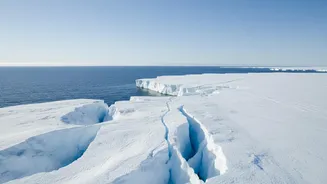
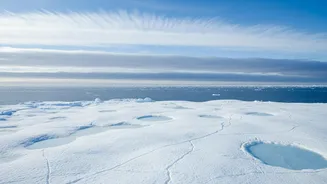
A recent study published in Nature Geoscience has provided a significant breakthrough. An international team of scientists, led by the University of Birmingham, has uncovered a previously unknown natural process that occurs at the marginal ice zone—the dynamic boundary where sea ice meets the open ocean. Their research, conducted aboard a research ship in the waters around Greenland, found that melting ice exposes the ocean to sunlight, triggering a chemical reaction involving marine life. This process releases a powerful cocktail of iodine, sulphur, and organic compounds into the atmosphere.
From Ocean Life to Cloud Seeds
The study offers the first real-world evidence of a mechanism that was previously only demonstrated in laboratory experiments at CERN. As marine life like algae releases gases, sunlight transforms them into sulfuric acid and iodine acids. These chemicals combine to form tiny new atmospheric particles. The researchers observed that on sunny days, this process was remarkably efficient, increasing the number of particles capable of seeding cloud droplets by as much as fifty-fold in a single day. Essentially, as the Arctic warms and more sea ice melts, it creates more of this productive ice edge, which in turn manufactures more cloud-forming particles in a powerful feedback loop.
Why This Discovery Matters for Climate Models
This discovery is a game-changer for climate science because current global climate models do not account for this specific chemical pathway. The omission helps explain why models have struggled to accurately simulate the number of particles observed in the Arctic atmosphere. By incorporating this new understanding of how particles are formed from a combination of iodine and sulphur compounds, scientists can create much more accurate simulations of Arctic cloud cover. This is crucial because the effect of these extra clouds is complex; they might accelerate ice melt by trapping heat over the ice, but could also cool the open ocean by reflecting sunlight. Understanding this balance is essential for predicting future climate change, not just in the Arctic but globally, as changes in the polar regions have ripple effects on weather patterns worldwide.