




A Chaotic Solar Nursery
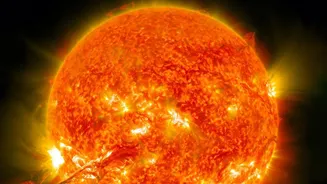
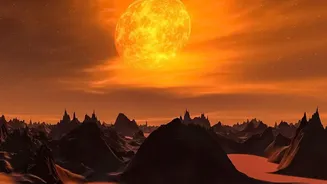
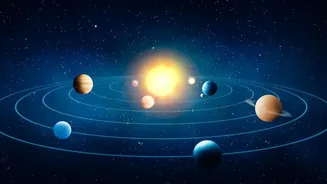
The birth of our solar system, around 4.6 billion years ago, was far from the orderly dance of planets we see today. It began as a vast, swirling disk of gas and dust around the infant Sun. This early environment was a chaotic and crowded place where
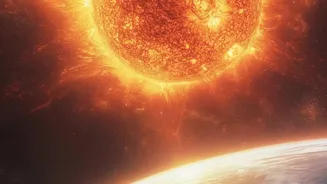
planetary building blocks constantly collided and interacted. A recent study published in the journal Monthly Notices of the Royal Astronomical Society proposes a dramatic event from this era: the Sun may have consumed a 'super-Earth'—a planet several times the mass of our own. This idea stems from trying to solve several long-standing puzzles about our star that standard models of stellar evolution can't quite explain.
The Missing Super-Earth
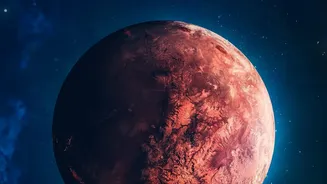
One of the driving questions behind this theory is a curious absence in our own cosmic neighbourhood. While astronomers have found super-Earths to be common in other star systems, our solar system doesn't have one. Previous research suggested that one or more of these large rocky planets could have formed close to the Sun, perhaps within the orbit of Mercury, before spiraling inward and disappearing. The new research, led by Professor Mutlu Yildiz of Ege University in Turkey, takes this a step further by asking if we can still see the evidence of this ancient collision inside the Sun itself. The models suggest that a planet between five and ten times the mass of Earth falling into the Sun could account for some of our star's peculiarities.
Fingerprints of a Swallowed Planet
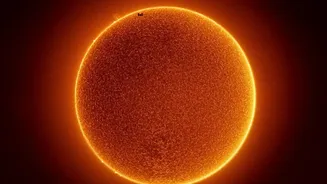
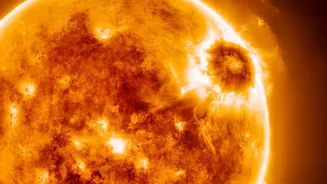
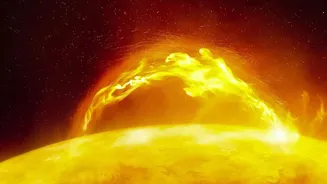
So, what are these solar mysteries? The first is the Sun's chemical composition. In astronomy, any element heavier than hydrogen and helium is called a 'metal'. Scientists have noted that the Sun has an unusually low amount of the element lithium on its surface compared to similar stars. The second puzzle involves subtle differences between the Sun's observed internal structure—things like the depth of its outer convective layer—and what the best stellar models predict. The study found that simulating the engulfment of a super-Earth can resolve both issues at once. The heavier elements from the consumed planet would have settled deep inside the Sun, altering its composition and structure in a way that aligns better with what we observe today. As Professor Yildiz noted, the material from a planet is chemically different from the gas the Sun formed from, leaving a potential 'chemical signature'.
Searching for Proof in the Sun's Heart
While the computer models are compelling, they don't yet count as definitive proof. Other explanations for the Sun's unique characteristics might still be possible. The next step for scientists is to look for independent confirmation of these chemical and structural fingerprints. The primary tool for this would be helioseismology, the study of the Sun's interior by observing the sound waves that vibrate through it. Just as seismology reveals the inner layers of the Earth, helioseismology can map the Sun's core and convective zones. If these observations can detect the specific kind of chemical layering and structural changes predicted by the planet-engulfment model, it would provide powerful evidence for this dramatic event. Proving that our Sun is a planet-eater would not only solve a few solar puzzles but also confirm that stars can preserve the evidence of planets they destroyed billions of years ago.