



An Inhospitable Paradise?
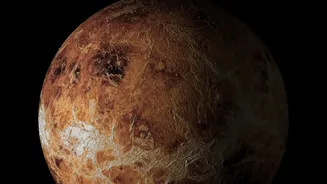
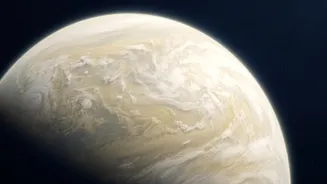
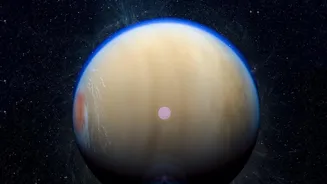
For decades, Venus has been a symbol of planetary catastrophe. Its surface is hot enough to melt lead, and its atmosphere is so dense it would crush a submarine. Dominating this hellish landscape is a thick, perpetual blanket of clouds made of highly
concentrated sulfuric acid—essentially battery acid. This environment was largely written off as completely inhospitable to life as we know it. Yet, a specific layer in these clouds, about 48 to 60 kilometres up, features temperatures and pressures surprisingly similar to Earth's. This has made the Venusian clouds a tantalizing, if paradoxical, target in the search for extraterrestrial life. The main obstacle has always been the chemistry. How could the complex molecules necessary for biology possibly survive in an acid bath?
Life's Building Blocks in an Acid Test
Recent laboratory experiments, led by scientists at MIT, have provided a stunning new perspective. Their research, published in the Proceedings of the National Academy of Sciences, found that peptides—short chains of amino acids that are the fundamental building blocks of proteins—can survive in concentrated sulfuric acid. This finding is a game-changer. Previously, it was assumed that the acid would immediately destroy these crucial organic molecules. The experiments showed that in a solution of 98% sulfuric acid, the near-total absence of water actually prevents the chemical reaction that typically breaks peptides apart. For weeks, these molecules remained stable, challenging a core assumption about the limits of life.
More Than Just Survival
The discovery went beyond mere survival. The researchers observed that the peptides didn't just endure the harsh conditions; they also folded into stable, three-dimensional structures. This is a critical detail because a molecule's shape determines its function. A folded peptide has the potential to perform complex biological tasks, something a simple, unfolded chain cannot do. While this laboratory finding is not proof of life on Venus, it demonstrates that one of the biggest barriers to life's chemistry in the clouds might not be as insurmountable as once believed. It opens the door to the possibility that meteorites, which regularly deliver amino acids and other organic materials to Venus, could be supplying the raw ingredients for a form of biology we have yet to imagine.
Rethinking Planetary Habitability
This new insight forces a broader re-evaluation of what makes a planet potentially habitable. For a long time, the search for life has focused on finding Earth-twins with abundant liquid water. This research suggests that the chemistry required for life might be possible in environments that are profoundly different from our own. It doesn't mean Venus is teeming with floating microbes, but it does mean we can’t rule it out based on the acidic environment alone. Some scientists have also explored other chemical puzzles in the Venusian clouds, such as the unexpected presence of ammonia, which could potentially neutralize some of the acid and create more habitable pockets. Each new finding adds another layer of complexity to Venus, transforming it from a simple wasteland into a dynamic and mysterious chemical laboratory.
The Next Chapter for Venus
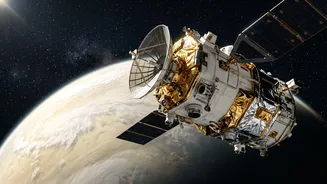
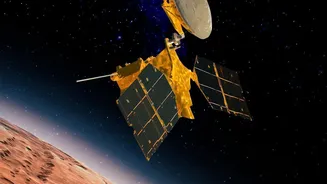
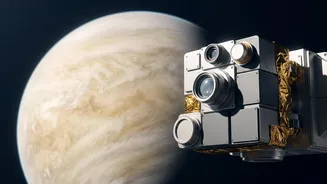
Ultimately, laboratory experiments can only take us so far. To confirm what is truly happening in Venus's clouds, we need to go back. Upcoming missions are poised to do just that. NASA's DAVINCI mission, for example, will drop a probe through the planet's atmosphere, measuring its composition with unprecedented detail as it descends to the surface. These direct measurements will be crucial for verifying the chemical environment and searching for the kinds of complex molecules that the MIT study showed could survive there. The latest research provides a powerful new reason to explore our celestial neighbour, shifting the focus from simply studying a dead planet to investigating a world that may hold some of life's most surprising secrets.