



A Famous Stellar Nursery
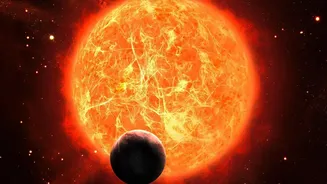
Located a mere 63 light-years from Earth, the Beta Pictoris system is a cosmic celebrity among astronomers. At only about 23 million years old, it is a stellar infant compared to our own 4.6-billion-year-old Solar System. This youth makes it a perfect
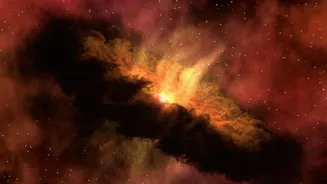
natural laboratory for studying how planetary systems form. For decades, scientists have observed its huge, bright disk of dust and debris—the leftover raw material from which planets are born. This debris disk was the first of its kind to ever be directly imaged, offering a rare, edge-on view of a planetary system in the making. Prior to this new discovery, astronomers had already confirmed two massive gas giants, Beta Pictoris b and c, orbiting the star.
The Surprise: Hiding in Plain Sight
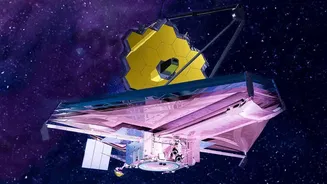
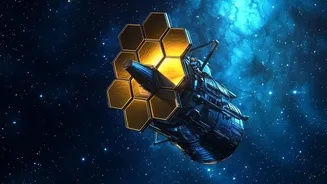
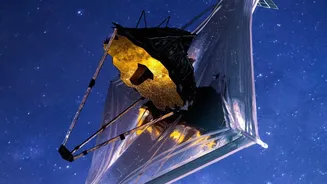
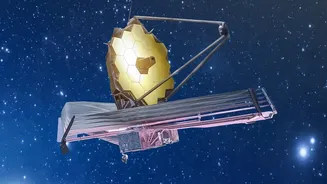
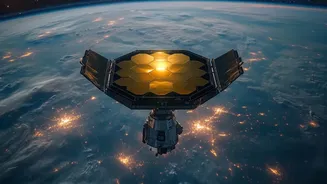
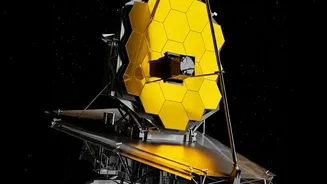
The existence of a third planet had been theorized for years. Scientists noticed that the structure of the famous debris disk, particularly its sharply defined inner edge, couldn't be fully explained by the gravity of just planets b and c. Something else had to be there, sculpting the disk. The problem was that the disk itself, being so bright, created a cosmic fog that made it incredibly difficult to spot a faint planet hiding within it using traditional imaging methods. The big surprise came when researchers using the JWST weren't even looking for a new planet. They were studying the known planet, Beta Pictoris b, when a tell-tale signal appeared in the data right where they expected to see only dust.
A New Way to Find Worlds
Instead of spotting Beta Pictoris d as a point of light, the JWST found it by detecting the chemical fingerprint of its atmosphere. Using the Near-Infrared Spectrograph (NIRSpec) instrument, the team identified the unmistakable absorption lines of methane, carbon monoxide, and water vapor. This technique, known as moderate-resolution spectroscopy, allowed them to effectively see through the dusty haze and confirm the presence of a planet by its chemical composition alone. It marks the first time a directly imaged planet has been discovered primarily through this method, opening up a powerful new strategy for finding exoplanets that are otherwise camouflaged by their environment. The discovery was later independently verified by a separate team using the European Southern Observatory's Very Large Telescope, who found traces of the planet in archival images stretching back over a decade.
What This Discovery Means
The confirmation of Beta Pictoris d is a huge step forward. Estimated to be at least twice the mass of Jupiter, it is the smallest of the three planets in the system but has the widest orbit. Its position near the inner edge of the debris disk provides direct evidence for the long-held theory that planets gravitationally sculpt these disks. With three confirmed planets, Beta Pictoris becomes only the second system (after HR 8799) where more than two planets have been directly imaged. This gives astronomers an unprecedented opportunity to compare the formation and atmospheres of multiple planets that were all born from the same material in the same environment, offering crucial insights into the processes that shape planetary systems, including our own.