


Our Closest Galactic Neighbor
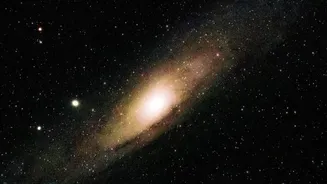
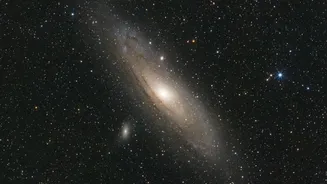
On a clear, dark night, the Andromeda galaxy is just visible to the naked eye as a faint, fuzzy patch of light. Located 2.5 million light-years away, it is the closest major galaxy to our own Milky Way. For astronomers, its proximity makes it an invaluable
laboratory for understanding how large spiral galaxies form and evolve. Because we are inside the Milky Way, we can't get a bird's-eye view of our own galactic structure. Andromeda, however, offers us a complete picture, allowing us to study its past and present in stunning detail. For decades, it was considered a quiet, steady counterpart to our home galaxy, but new research is challenging that view.
Hubble's Galactic Fossil Hunt
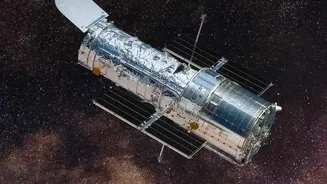
To piece together Andromeda's history, astronomers launched one of the most ambitious observing programs ever undertaken by the Hubble Space Telescope. The project, combining the Panchromatic Hubble Andromeda Treasury (PHAT) and Southern Treasury (PHAST) surveys, meticulously mapped about two-thirds of the galaxy's sprawling disk. This effort wasn't about taking a single pretty picture; it was a cosmic archaeological dig. Hubble resolved an astounding 200 million individual stars, treating them as fossils. The colour of a star reveals its age: massive, hot stars burn blue and die young, while smaller, cooler stars glow red and live for billions of years. By analysing the mix of stellar colours across the galaxy, scientists could rewind time and reconstruct its history.
A Tale of Boom and Bust
The study's findings painted a surprising picture of Andromeda's life. Far from being steady, its star production has been a story of boom and bust. Around 2 billion years ago, the galaxy experienced a massive burst of star formation, likely triggered by a merger with another, smaller galaxy. Since that intense period, however, things have been quieting down. New data reveals that over the last 500 million years, Andromeda's rate of star creation has steadily declined. About 500 million years ago, it was forming stars at a rate comparable to the Milky Way today—roughly one sun's worth of mass per year. But that rate has plummeted, especially in the last 40 million years, and now sits at just one-fifth of a solar mass per year.
The Fading Ring of Fire
So, is Andromeda simply running out of gas for new stars? The study suggests the answer is more complex. Researchers found that much of the galaxy's recent star-making has been concentrated in a massive ring of gas and dust located about 32,000 light-years from its center. This 'ring of fire' was once incredibly active, but its productivity is now fading, and this slowdown is driving the entire galaxy's decline. This isn't because the raw materials have vanished, but rather seems to be a natural winding-down process after the energetic burst 2 billion years ago. It’s as if the galaxy is taking a breather after a marathon run of star birth.
Cosmic Clues and Future Collisions
The detailed history provided by Hubble gives crucial context to other features of Andromeda. For instance, some of the slowdown, particularly in certain regions, might be linked to interactions with its small companion galaxy, M32. While not definitive, the timing aligns with a decrease in star formation that began around 60 million years ago in areas M32 may have passed through. Understanding Andromeda's past is also a glimpse into our own future. The Milky Way and Andromeda are on a collision course, set to merge in about 4.5 billion years. Knowing how Andromeda reacted to past mergers and how its star formation has evolved helps scientists build more accurate models of this future cosmic dance, which will ultimately create a single, giant new galaxy.