





The Foundation: What is Individual Mobility?
Before comparing these two activities, it is crucial to understand the concept of mobility. Often confused with flexibility, mobility is your ability to actively and controllably move a joint through its full range of motion. Think of it as usable flexibility.
While flexibility is the passive ability for a muscle to be stretched, mobility involves the strength and control to get into and out of those positions. Poor mobility can lead to improper form, compensatory movements, and an increased risk of injury, no matter the activity. Better mobility allows for more efficient movement patterns, which directly translates to improved performance and endurance.
Tai Chi: The Path of Grounded Movement
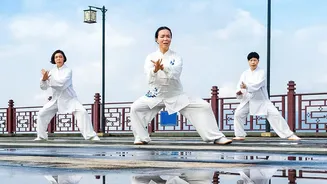
Tai Chi is often described as 'meditation in motion'. This ancient Chinese martial art involves slow, deliberate, and flowing movements that challenge the body in subtle yet profound ways. Its primary focus is on balance, posture, and the mindful transfer of weight. To perform the deep stances and graceful shifts, you need significant mobility in your lower body. This includes ankle flexibility to keep your feet grounded, hip mobility to sink into stances and shift weight, and good coordination. The practice itself is excellent for improving balance, flexibility, and proprioception—your body's awareness of its position in space. If your hips are tight or your balance is poor, you will find the foundational movements challenging, but consistent practice is proven to improve these very areas.
Kayaking: The Rhythm of Core and Water
On the surface, kayaking looks like an arm workout, but effective paddling is a full-body endeavour driven by the core. The power for each paddle stroke should originate from the rotation of your torso, not from pulling with your arms. This requires excellent rotational mobility in the thoracic spine (your upper and mid-back). Furthermore, sitting comfortably and maintaining stability in a kayak demands flexible hip flexors and a strong, engaged core. If your upper back is stiff, you will be forced to rely on your smaller shoulder and arm muscles, leading to rapid fatigue and potential injuries like shoulder impingement. Similarly, tight hips can cause lower back pain after even a short time on the water.
A Direct Comparison of Mobility Demands
When placed side-by-side, the mobility demands of Tai Chi and kayaking present a study in contrasts. Tai Chi is a weight-bearing activity that fundamentally tests and develops ground-up stability. It relentlessly exposes weaknesses in lower-body mobility—from the soles of your feet to your hips—and your ability to balance on one leg. Kayaking, on the other hand, is a seated, non-weight-bearing activity. Its primary mobility challenge is rotational and focused on the upper body. It will quickly reveal a stiff thoracic spine and weak core stabilisers, which are common issues for people with desk jobs. An individual with great upper-body rotation might struggle with the deep stances of Tai Chi, while a person with flexible hips might find their shoulders and back ache after kayaking due to a lack of torso mobility.
Choosing Your Path to Better Movement
Ultimately, the choice between Tai Chi and kayaking should be informed by your personal mobility landscape. Neither is inherently 'better'; they simply test and build the body in different ways. A self-assessment can be revealing. Can you sit on the floor comfortably for an extended period? If not, the seated position in a kayak might be challenging initially. Can you balance on one leg for 10 seconds? If this is difficult, Tai Chi will directly address that weakness. Your starting point determines your journey. If your goal is to improve ground-based balance and lower-body control, Tai Chi offers a direct path. If you want to build rotational core power and upper-body endurance in a low-impact setting, kayaking is an excellent choice. Both activities are fantastic for overall health, stress reduction, and connecting with your body.