



From Startup to Sky-High Ambitions
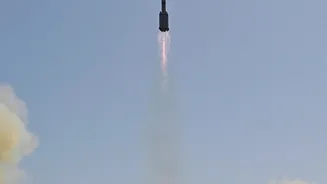
Founded in 2018 by former ISRO scientists, Skyroot Aerospace quickly became a trailblazer in India’s newly liberalised space sector. The company made history in November 2022 with the successful suborbital flight of its Vikram-S rocket, the first privately
developed rocket in India to do so. This achievement was a crucial technology demonstration, validating the company's in-house propulsion and avionics systems. Following this success, Skyroot achieved another major milestone on July 18, 2026, with the successful maiden orbital launch of its Vikram-1 rocket. This launch not only placed customer payloads into a 450 km orbit but also made India the third country, after the US and China, to have a private company achieve orbital launch capability. This has positioned Skyroot, now a space-tech unicorn valued at over $1 billion, as a serious contender in the global space market.
The Vikram Rocket Lineup
Skyroot's strategy hinges on its family of launch vehicles, named after Dr. Vikram Sarabhai, the father of India's space programme. This family is designed for incremental growth. The journey started with the Vikram-S sounding rocket and has now progressed to the Vikram-1, an orbital vehicle designed to carry payloads of up to 480 kg into Low Earth Orbit (LEO). This rocket is tailored for the booming small satellite market, which demands dedicated, on-demand launches. The next step in the evolution is the Vikram-II. This rocket is designed to nearly double the payload capacity, aiming to lift up to 900 kg to LEO. It will incorporate a more efficient cryogenic upper stage powered by the in-house developed Dhawan-II engine, allowing for more complex missions like deploying satellite constellations. Further down the line is the Vikram-III, which is planned to carry payloads between 560 kg and 815 kg, depending on the orbit, representing another step up in capability. This phased approach allows Skyroot to build on its successes, refine its technology, and systematically address a wider segment of the launch market.
The Leap to Heavier Lifts
Moving from launching small satellites of a few hundred kilograms to payloads approaching one tonne (1,000 kg) is a significant jump in both technical capability and market opportunity. A one-tonne capacity opens the door to launching larger, more sophisticated satellites, including heavier Earth observation platforms, telecommunications satellites, and bigger batches of small satellites in a single mission. This capability would allow Skyroot to compete for more lucrative government and commercial contracts that are currently the domain of established global players. The Vikram-II, with its 900 kg capacity, is the key to this transition. Its development involves mastering cryogenic propulsion, a technology that offers higher performance but is notoriously complex. Skyroot has already conducted successful tests of its 3D-printed Dhawan-II cryogenic engine, a critical milestone for the Vikram-II program. Success with this rocket would transform Skyroot from a small satellite specialist into a versatile launch provider.
Navigating a Crowded Market
Skyroot's ambitions do not exist in a vacuum. The global launch market is fiercely competitive, with players like SpaceX and Rocket Lab dominating their respective segments. Domestically, Skyroot competes for talent and resources with both the state-run ISRO and a growing number of other private startups. However, India's space policy reforms since 2020 have created a supportive ecosystem, with IN-SPACe acting as a facilitator between private firms and ISRO, providing access to testing facilities and expertise. The Indian space economy is projected to grow from around $8.4 billion to $44 billion by 2033, creating a massive domestic opportunity. Skyroot's competitive edge lies in its focus on cost-effective manufacturing, using techniques like 3D printing and carbon-composite structures, and offering rapid, on-demand launch services tailored to the client's schedule rather than forcing them to rideshare on a larger rocket.
Challenges on the Final Frontier
The path from a successful first launch to becoming a reliable, high-frequency launch provider is long and fraught with challenges. One successful flight does not guarantee a business. The primary challenge for Skyroot will be to prove the reliability of its Vikram rockets through repeated successful launches and to establish a consistent launch cadence. The company has stated it aims to build capacity to produce one orbital rocket per month. Scaling up production, managing a complex supply chain with over 400 suppliers, and securing the necessary funding for developing the more advanced Vikram-II and reusable vehicle technologies are significant hurdles. The company has been successful in raising capital, with total funding exceeding $150 million from prominent investors like Singapore's GIC, Temasek, and BlackRock, but the capital-intensive nature of rocket development will require sustained financial backing.