

The Mystery of the Missing Moon
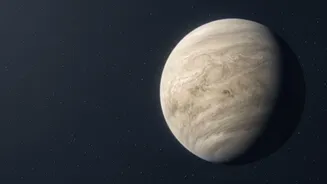
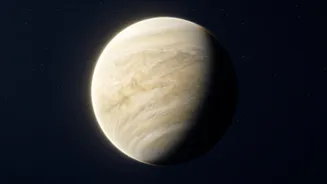
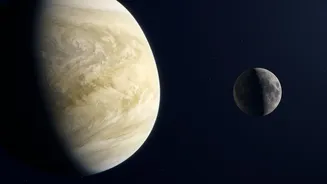
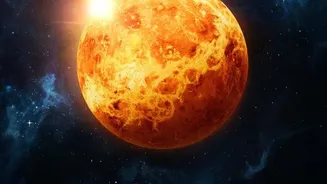
Venus and Earth are remarkably similar in size, mass, and composition, leading scientists to puzzle over their divergent paths. One of the biggest questions has been the absence of a Venusian moon. Prevailing theories previously fell into two camps: one,
that a catastrophic impact destroyed a pre-existing moon, and two, that Venus simply never had the right kind of cosmic collision to form one in the first place. However, a new study from researchers at the University of California, Riverside, offers a third, more intrinsic explanation. The answer, it seems, might not lie in an external catastrophe, but in the very nature of Venus itself.
A Tale of Two Rotations
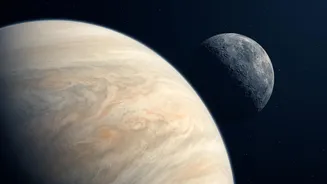
The key to this new theory lies in the vastly different rotational speeds of Earth and Venus. Our planet completes a spin in about 24 hours. This rapid rotation transfers energy to our Moon through tidal forces, causing it to slowly drift away from us at a rate of about four centimetres per year. We know this with incredible precision thanks to mirrors left on the lunar surface during the Apollo missions. Venus, however, is a galactic-scale slowpoke. It takes 243 Earth days to complete a single rotation. According to new computer simulations, this sluggish spin would have the opposite effect on a satellite. Instead of pushing it away, the planet's gravity would gradually reel it in.
The Inevitable Inward Spiral
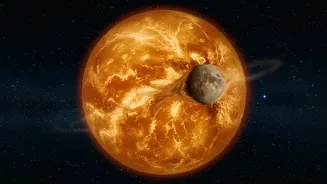
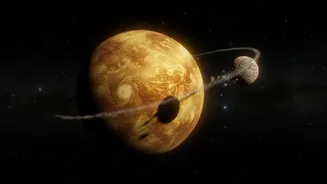
Astrophysicist Stephen Kane led the team that developed computer models to simulate the gravitational dance between Venus and a hypothetical moon. They tested a wide range of scenarios, varying the mass of the moon and the initial rotation speed of the planet. Across most simulations, the outcome was strikingly consistent: the moon would enter a decaying orbit, spiraling closer and closer to Venus until it ultimately crashed into the planet. In some scenarios, this destruction could happen in as little as 30 million years. The models showed that larger moons would actually meet their demise even faster, as their stronger gravitational pull would slow Venus's rotation more efficiently, accelerating the inward spiral.
What This Means for Venus and Beyond
These simulations do not prove that Venus ever had a moon, but they provide a plausible mechanism for its absence today without needing a second, moon-shattering impact. It suggests that a planet's ability to form a moon is only half the battle; it also needs to be able to keep it. The collision of a moon could have had a dramatic effect on Venus's history, delivering a massive burst of energy that may have influenced its atmosphere and contributed to its runaway greenhouse effect. This research also has implications for the search for life elsewhere. When astronomers spot Earth-like exoplanets, a key question is whether they have moons, which can play a crucial role in stabilizing a planet's climate. This study reveals a "disturbing scenario," as Kane puts it, where planets that don't spin fast enough may be destined to destroy their own satellites, potentially changing their evolutionary path forever.