

What Exactly Is a 'Fire Rainbow'?
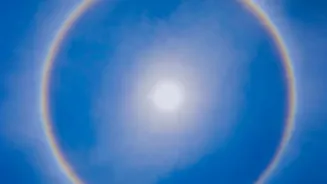
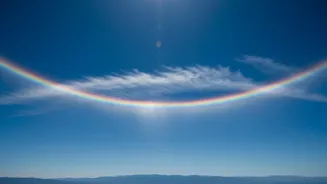
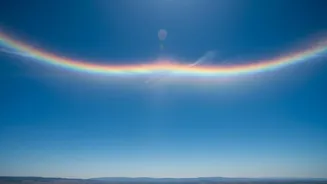
Despite its evocative name, a fire rainbow has nothing to do with fire and isn't a rainbow in the traditional sense. The correct scientific term for this optical event is a circumhorizontal arc. It's part of a family of atmospheric phenomena called ice
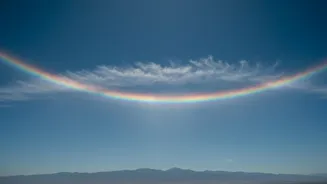
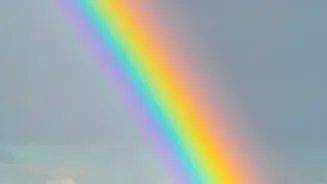
halos, which are created by the interaction of light with ice crystals suspended high in the atmosphere. Unlike a true rainbow, which is formed by the refraction and reflection of light in liquid water droplets and always appears opposite the sun, a circumhorizontal arc is formed purely by light refracting through ice. The 'fire' nickname comes from its flame-like, vibrant colours and the fact that it often appears in wispy cirrus clouds.
The Essential Ingredient: Plate-Shaped Ice Crystals
The single most important factor for a circumhorizontal arc to form is the presence of the right kind of ice crystals. The phenomenon occurs in high-altitude cirrus or cirrostratus clouds, where temperatures are so low that they are composed of tiny ice crystals instead of water droplets. For a fire rainbow to appear, these clouds must contain millions of flat, hexagonal, plate-shaped ice crystals. Crucially, these tiny plates must be oriented horizontally as they float through the air. This specific alignment allows the cloud to act like a single, giant prism, perfectly positioned to refract sunlight. Sunlight enters through the vertical side face of a crystal and exits through the bottom horizontal face, splitting the light into its constituent colours.
It's All About the Right Angle
Having the right clouds isn't enough; the sun must also be in a very specific position in the sky. For a circumhorizontal arc to become visible, the sun must be at an elevation of at least 58 degrees above the horizon. This is a very high angle, meaning the phenomenon is most commonly seen during the middle of the day in the summer months. The arc reaches its maximum intensity and brightness when the sun is around 68 degrees high. This strict requirement on the sun's angle is why fire rainbows are relatively rare and geographically limited. In locations north of 55° latitude (like much of northern Europe) or south of 55° latitude, the sun never gets high enough in the sky for a circumhorizontal arc to form.
NASA's Captivating View
NASA's Astronomy Picture of the Day (APOD) recently featured a stunning example of a circumhorizontal arc, drawing fresh attention to the phenomenon. The image, captured over West Virginia, showcases the vibrant, ribbon-like colours running parallel to the horizon. While this particular photo was taken in 2021, its selection by NASA highlights the unique beauty and fascinating physics of these arcs. Such images serve as a powerful reminder of the complex and beautiful optical displays that can unfold in our own atmosphere when conditions are just right. By featuring the image, NASA helps explain to a wide audience that what they are seeing is a result of ice crystals acting as millions of tiny, floating prisms.
How to Spot One Yourself
If you want to spot your own fire rainbow, you need to know what to look for. First, pay attention to the clouds. You need thin, wispy cirrus clouds high in the sky. Second, consider the time of day and year. Your best chance is during the late spring and summer months, around midday when the sun is at its highest point. Remember the 58-degree rule; if you're in a mid-latitude region (like most of the United States), the sun gets high enough during summer. The arc itself will appear as a colourful band parallel to the horizon, located well below the sun. Its colours are often more vivid and spectrally pure than those of a common rainbow. So next time it's a sunny day with some high, thin clouds, don't forget to look up—you might just get lucky.