



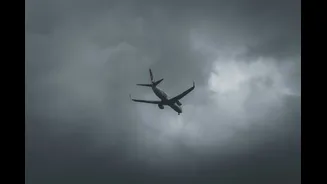
The Sky's Traffic Jam
The most frequent reason for circling is simple: air traffic congestion. Just like cars on a motorway during rush hour, aeroplanes need to be safely spaced out. Major airports handle a tremendous volume of flights, and if a few are running slightly behind
schedule or one takes longer to clear the runway, it creates a ripple effect. To manage this, Air Traffic Control (ATC) places incoming aircraft into a 'holding pattern'. This procedure acts as a buffer, keeping planes in a predictable, organized flow until it is their turn to land. Think of it as a waiting room in the sky, ensuring everyone gets to the gate safely and in an orderly fashion.
What is a Holding Pattern?
When you see a plane circling, it's not just flying in random loops. It is following a highly specific, predetermined flight path known as a holding pattern. This manoeuvre is typically a racetrack-shaped circuit flown around a specific navigational point, or 'fix'. This point can be a ground-based radio beacon or a satellite-defined waypoint, often located miles from the airport itself. Pilots, often with the help of the autopilot, fly this oval path with precision, maintaining a specific altitude to ensure they remain safely within a protected block of airspace while awaiting clearance to proceed with their approach.
Waiting on the Weather
Adverse weather is another primary factor that can pause landing procedures. Conditions like dense fog, heavy thunderstorms, or strong crosswinds can make landing unsafe. When visibility drops below required minimums or the wind is too challenging, ATC will delay landings until conditions improve. Holding patterns allow aircraft to wait in a safe area nearby, ready to resume their approach as soon as the weather clears, ensuring that the final descent and touchdown happen in the safest possible conditions.
Runway Not Ready
Sometimes the delay is due to an issue on the ground. The runway might be temporarily unavailable for a number of reasons. Another aircraft might be slow to exit the runway after landing, or a vehicle might be performing a last-minute inspection. In rarer cases, debris might need to be cleared, or an aircraft on the ground might have a mechanical issue that prevents it from moving. An 'aborted landing' or 'go-around' by a preceding aircraft can also cause a brief pause. In these instances, ATC will instruct approaching planes to circle until the runway is confirmed to be clear and safe for landing.
The Need to Lose Weight
An aircraft's maximum safe landing weight is lower than its maximum takeoff weight. This isn't an issue for most flights, as the fuel burned during the journey reduces the plane's weight to a suitable level for landing. However, if a plane has to return to the airport shortly after takeoff—perhaps due to a minor technical issue or a medical emergency—it may be too heavy to land safely. In this situation, the aircraft will be put into a holding pattern to burn off fuel, which is the most common method. For some larger, long-haul aircraft in more urgent situations, a procedure called 'fuel jettisoning' might be used, where fuel is safely released at high altitude to reduce weight more quickly.