






Our Galaxy's Puzzling Slant
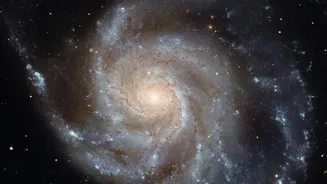
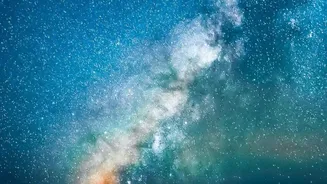
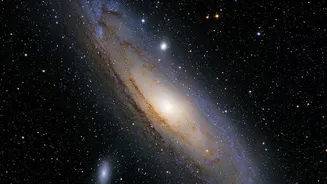
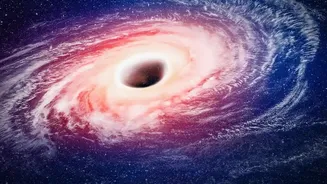
When we picture the Milky Way, we often imagine a flat, spinning disc of stars, gas, and dust. For the most part, that’s accurate. But our galaxy has long held a few secrets. One of the biggest mysteries relates to its stellar halo—a vast, sparse sphere
of ancient stars that surrounds the main disc. Observations from the European Space Agency's Gaia mission revealed that this halo rotates incredibly slowly, at just 10-20 kilometres per second, while the main disc zips around at over 220 kilometres per second. This discrepancy has puzzled astronomers for years, suggesting our galaxy’s history is far more turbulent than its calm appearance would suggest.
A Collision of Galactic Proportions
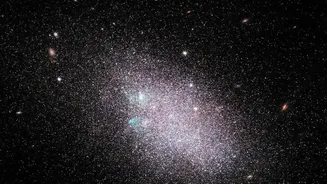
New research points to a dramatic cause for this slow halo: a massive, head-on collision with another galaxy that occurred between 8 and 11 billion years ago. The culprit was a dwarf galaxy that astronomers have whimsically named Gaia-Sausage-Enceladus (GSE). This smaller galaxy, though still enormous with a mass billions of times that of our sun, plunged into the young Milky Way. Over time, the immense gravity of our galaxy tore GSE apart, absorbing its stars into what is now our stellar halo. The name 'Sausage' comes from the elongated, sausage-like shape that these captured stars form in velocity plots as they orbit the galactic centre.
The Evidence in the Stars
Astronomers can’t directly witness an event that happened billions of years ago. Instead, they act like cosmic detectives, piecing together clues from a fossil record written in the stars. A team from Durham University used powerful supercomputer simulations to model the evolution of galaxies like ours. They found that galaxies with slow-moving stellar halos almost always had two things in common: they had experienced a major head-on merger like the one with GSE, and their main disc had undergone a significant 'flip'. The motions and chemical compositions of the stars from the GSE merger, still identifiable today, provide the crucial evidence of this violent encounter that reshaped our galaxy.
The Great Galactic Flip
So, how does a galaxy flip? It doesn’t happen overnight like a pancake. A 'flip' is defined as a gradual change in the galaxy's axis of rotation by more than 90 degrees. According to the simulations, the immense gravitational force from the GSE merger could have acted like a powerful nudge on a spinning top. This caused the entire disc of the Milky Way to slowly wobble, or 'precess', over hundreds of millions to billions of years. This gradual but massive reorientation would have shifted the entire plane of our galaxy, tilting it into a completely new position relative to its dark matter halo.
A New History for Our Home Galaxy
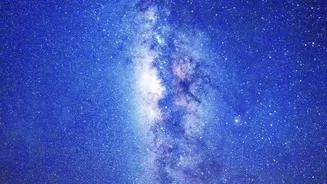
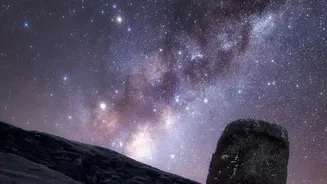
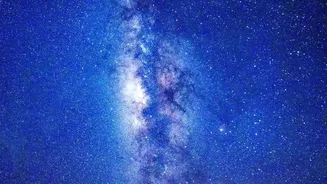
This discovery fundamentally changes our understanding of the Milky Way's evolution. It suggests our galaxy’s past was far more violent and dynamic than previously believed. The ancient collision with GSE didn’t just add new stars; it physically reoriented the entire structure, helping to explain not only the slow halo but also other features like the 'warp' seen in the Milky Way's disc. This means that the stable patch of the galaxy our solar system currently occupies might not have always been so quiet. The serene band of stars we see arching across the night sky is the result of a colossal cosmic collision that set our galaxy on a new path billions of years ago.