




A Ghostly Glow in the Galaxy
Scientists are pointing to a mysterious source of high-energy gamma rays as the potential remnant of a kilonova—a catastrophic collision between two neutron stars. The source, known as HESS J1507−622, has puzzled astronomers since it was first detected
by telescopes in Namibia between 2006 and 2007. What makes it so unusual is that it emits powerful gamma rays without any corresponding light in other wavelengths, like radio or X-rays. It also sits curiously outside the main plane of the Milky Way, where most of our galaxy's stars reside. A new, yet-to-be peer-reviewed study posted to the preprint server arXiv suggests that these features are best explained by the aftermath of a neutron star merger. If confirmed, it would be the first such kilonova remnant ever identified within our home galaxy.
What is a Kilonova?
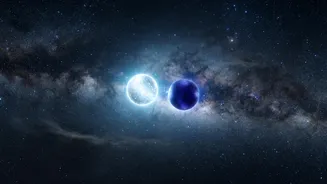
Imagine objects so dense that a single teaspoon of their material would weigh a billion tonnes. These are neutron stars—the collapsed cores of massive stars that have exploded as supernovae. Sometimes, two of these stellar remnants are locked in a binary system, orbiting each other. Over millions of years, they radiate energy away as gravitational waves, spiralling closer and closer until they violently collide. This merger unleashes a tremendous blast of energy and ejects a cloud of neutron-rich material. The event is called a kilonova. While it is more than a thousand times brighter than a regular nova, it's only about 1-10% as bright as a typical supernova, making them difficult to spot. The glowing, expanding cloud of debris is powered by the radioactive decay of heavy elements created in the initial cataclysm.
The Universe's Ultimate Gold Factory
The incredible violence of a kilonova provides the universe with its primary forge for the heaviest elements. While stars create lighter elements like oxygen and carbon through fusion, it takes the extreme conditions of a neutron star merger to create materials like gold, platinum, and uranium. This process, known as the rapid neutron capture process (or r-process), happens when atomic nuclei are bombarded with a flood of neutrons, quickly transforming them into heavier elements. The first direct evidence of this came in 2017, when astronomers detected both gravitational waves and electromagnetic light from a kilonova 130 million light-years away, confirming that these events produce vast quantities of heavy elements—a single merger can create several Earth masses of gold. Finding a remnant in our own galaxy brings this cosmic alchemy much closer to home.
Solving an Astronomical Mystery
The kilonova hypothesis neatly explains the strange characteristics of HESS J1507−622. A binary neutron star system can get a powerful 'kick' when one of the stars goes supernova, flinging it out of the main galactic disk, which would explain the source's odd location. Researchers developed a model of a hypothetical kilonova and found it could reproduce the specific gamma-ray emissions seen from the source. Their analysis suggests the explosion was relatively recent in cosmic terms, likely occurring less than 1,000 years ago, which explains why the remnant is still bright and compact. Although an event that bright would have been visible to the naked eye, its position in the southern sky might have made it difficult for ancient astronomers in the Northern Hemisphere, who kept detailed records, to observe.
The Next Steps for Confirmation
While the evidence is compelling, the conclusion that HESS J1507−622 is a kilonova remnant is still a hypothesis based on modeling. The study's authors stress that their work makes a strong case, but further observations are needed for definitive proof. This discovery is part of a larger, exciting hunt for these rare events. Astronomers estimate that only about ten systems capable of producing a kilonova exist in the entire Milky Way, making them a 'one-in-ten-billion' find. Confirming a remnant within our galaxy would provide an unprecedented opportunity to study the aftermath of one of the universe's most powerful events up close and better understand how the very elements that make up our world are created and distributed across the cosmos.