






A New Generation of Explorer
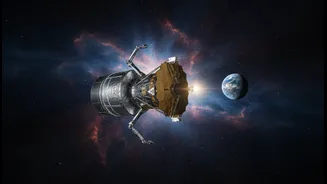
Set to launch in the late 2030s or early 2040s, the Habitable Worlds Observatory is NASA's next flagship astrophysics mission. Its primary goal is breathtakingly ambitious: to become the first telescope designed specifically to find and characterize at least
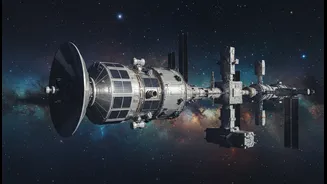
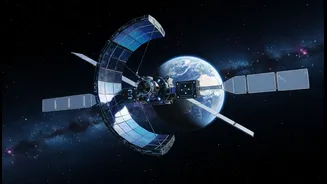
25 Earth-like planets, searching their atmospheres for chemical signs of life, or 'biosignatures'. Following in the footsteps of the Hubble and James Webb Space Telescopes, HWO will observe the universe in infrared, optical, and ultraviolet light. However, unlike its predecessors, HWO is being built on a fundamentally different philosophy, one that prioritizes longevity, upgradability, and a sustainable presence in deep space.
Learning from a One-Shot Mission
The James Webb Space Telescope (JWST) is an engineering marvel, delivering stunning images and groundbreaking science. But its deployment was an all-or-nothing affair. Launched to its operational orbit 1.5 million kilometers from Earth, JWST had to unfold its complex sunshield and mirrors perfectly, with no possibility of a human repair mission if something went wrong. While Hubble was famously serviced by astronauts in low-Earth orbit, JWST's distant location at the L2 Lagrange point makes a similar human-led repair mission impossible with current technology. NASA is taking these lessons to heart. HWO will also operate at L2, but it is being designed from the ground up with a crucial new capability: robotic servicing.
The Modular, Upgradable Telescope
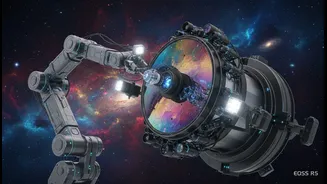
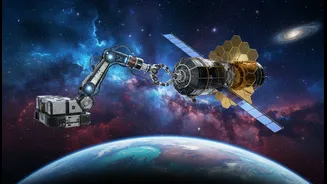
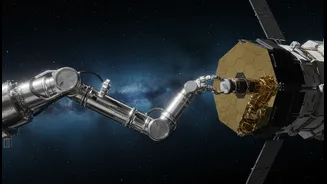
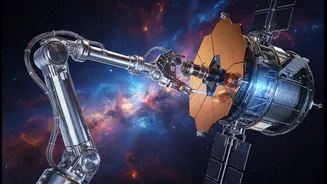
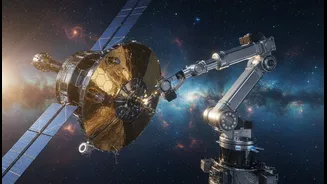
The core principle redefining HWO's construction is modularity. Instead of a single, fixed instrument, NASA is mandating that HWO be built with standardized, line-replaceable units. This means critical components—from scientific instruments and computers to sensors—can be swapped out over time. Imagine a future where a robotic spacecraft latches onto the observatory, slides out an older camera, and inserts a brand new one with next-generation technology. This approach, known as In-space Servicing, Assembly, and Manufacturing (ISAM), transforms the telescope from a static, one-time deployment into a long-term, upgradable asset in space. It not only extends the mission's life indefinitely but also mitigates risk; a single component failure no longer means the end of an entire multi-billion dollar observatory.
Robots as the New Astronauts
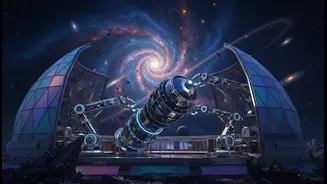
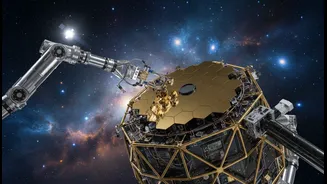
Since astronauts can't travel to L2 for a service call, HWO will rely on advanced robotic servicers. These autonomous or remotely operated spacecraft will be the mechanics of the future, performing complex tasks like replacing modules and even performing repairs. This reliance on robotics also opens up new possibilities for the telescope's initial assembly. If the final design is too large to fit into a single rocket fairing, robots could be used to assemble the primary mirror segments directly in orbit, allowing for an even larger and more powerful observatory than could be launched fully assembled. Companies are already being contracted to study and develop the servicing architecture and protocols needed for this ambitious plan.
The Tech Behind the Search
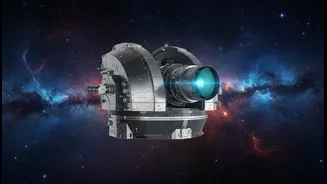
To find faint, rocky planets next to their blindingly bright host stars, HWO needs extraordinary technology. The main tool will be an advanced internal coronagraph, a device that blocks starlight with incredible precision—suppressing it by a factor of 10 billion. This requires a level of stability over 100 times better than that of the James Webb Space Telescope, with mirrors that can't vibrate more than a fraction of a single atom's diameter. This stability will allow HWO to create a tiny “dark hole” around the star, revealing the faint light of a planet within it. By analyzing that light, scientists can search for the telltale atmospheric signatures of oxygen, methane, and water—the building blocks for life as we know it.