



Cosmic Archaeology
Imagine trying to piece together the history of an ancient city by studying the people living there today. That’s essentially what galactic archaeologists do. Using powerful tools like the European Space Agency’s Gaia space telescope, astronomers can
precisely map the positions, movements, and chemical makeup of billions of stars. By identifying groups of stars with similar ages and orbits, they can trace them back to ancient galaxies that were long ago absorbed into the Milky Way. This work has revealed our galaxy has a complex family tree, built over billions of years through numerous mergers with smaller galaxies.
Meet Shakti and Shiva
The latest and most ancient ancestors to be identified are two structures named Shakti and Shiva. Discovered by astronomers Khyati Malhan and Hans-Walter Rix, these are not galaxies in themselves, but vast streams of stars, each containing the mass of around 10 million suns. These stars are incredibly old, estimated to be between 12 and 13 billion years old, placing their arrival at the very beginning of the Milky Way’s formation. They were found by sifting through Gaia data and identifying clusters of ancient, chemically simple stars that moved together in unusual orbits, suggesting they didn't originate in our galaxy but were intruders from a bygone cosmic era.
A Collision of Titans
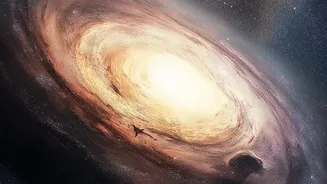
The arrival of Shakti and Shiva was no gentle affair. This event, happening so early in the universe's history, was a foundational moment for our galaxy. Unlike later, more well-known mergers like the one with the Gaia-Sausage-Enceladus galaxy around 10 billion years ago, the Shakti and Shiva merger occurred when the Milky Way was just a proto-galaxy, a mere infant. This collision of titans was so energetic that it had a profound effect on the galaxy's existing structure, which at the time was likely a primordial, cool disc of gas and stars.
Resetting the Galactic Disc
This is where the idea of a galactic “reset” comes in. The energy injected by the Shakti and Shiva merger would have been immense, heating the primordial gas disc of the proto-Milky Way. This violent event likely disrupted and ultimately destroyed that first-generation disc. While destructive, this cleared the slate. After the chaos subsided and the galaxy settled, the conditions were set for a new, more stable disc to form. This later formation became the familiar thin and thick discs of the Milky Way that we see today, where our own solar system resides. In a way, this early violent merger was a necessary act of creative destruction.
Rewriting Our Origin Story
This discovery helps solve a long-standing puzzle. Astronomers had noted that compared to similar spiral galaxies, the Milky Way seemed to get a late start in forming its large disc. The violent merger with Shakti and Shiva provides the perfect explanation. It suggests our galaxy had an initial disc that was effectively erased, pushing back the formation of the modern disc. By identifying these ancient building blocks, researchers can now see the first steps of our galaxy's growth from its 'poor old heart' towards the grand structure it is today. It paints a picture of a far more dynamic and chaotic youth than was previously understood.