




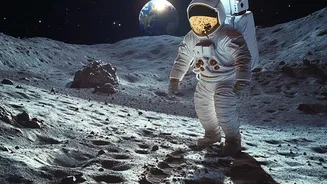

The Accidental Astronauts
Every time humanity sends a probe or a person to another world, we unintentionally send billions of microscopic hitchhikers. Despite the best sterilisation efforts, some hardy bacteria inevitably cling to spacecraft components. The International Space
Station (ISS) is a known habitat for various microbes, with some even surviving on its exterior. This isn't a new concern. A famous, though now debated, incident involved the Apollo 12 mission in 1969. Astronauts retrieved a camera from the Surveyor 3 probe, which had been on the Moon for 31 months. Upon its return to Earth, technicians reported finding a colony of the common bacterium Streptococcus mitis alive inside. While later analysis suggested this might have been a case of contamination after its return, the event highlighted a startling possibility: life from Earth could potentially survive a lunar vacation.
Surviving the Unsurvivable
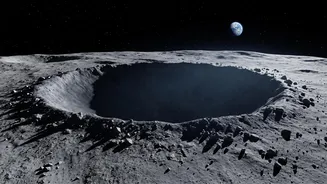
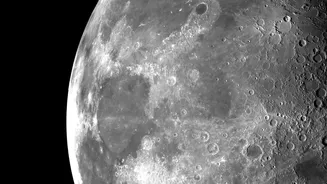
The lunar surface is no holiday resort. With no atmosphere, it’s a vacuum exposed to extreme temperature swings—from scorching heat to bone-chilling cold—and a constant barrage of cosmic and solar radiation. So how could a microbe possibly survive? The answer lies with a group of organisms called extremophiles, nature's ultimate survivors. Certain bacteria can enter a state of suspended animation called cryptobiosis, forming a tough, protective shell known as an endospore. This dormant state shuts down all biological processes, allowing them to endure conditions that would instantly kill most other life forms. A recent NASA-led study found that shaded areas, particularly in craters near the Moon's south pole, could shield microbes from the most damaging ultraviolet radiation. These pockets could allow some fungi and bacteria to survive for weeks or even months.
A Long, Deep Sleep
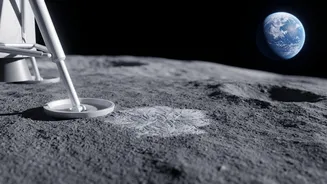
The headline claim of surviving for "years" is not science fiction. Experiments on the ISS have shown that bacteria like Deinococcus radiodurans, nicknamed "Conan the Bacterium" for its incredible toughness, can survive for at least three years in open space when clustered in aggregates. The outer layers of the cluster die, forming a protective shield for the microbes inside. Based on these findings, scientists estimate that a sufficiently thick clump of bacteria could survive a journey from Earth to Mars. On the Moon, if microbes were to be buried under a thin layer of lunar soil (regolith), perhaps by a micrometeorite impact or the landing of a subsequent spacecraft, they would be shielded from radiation. This protection could theoretically extend their dormant survival for thousands or even millions of years.
The Planetary Protection Problem
The survival of Earth microbes on the Moon has significant implications for future exploration. It’s a core concern of "planetary protection," the international effort to prevent biological contamination between worlds. There are two main risks. The first, called "forward contamination," is what we've been discussing: introducing Earth life to another celestial body. This could compromise the search for genuine extraterrestrial life. If we find microbes on the Moon or Mars, how can we be sure they aren't just our own contamination? This is why space agencies like NASA and ESA have strict protocols for cleaning spacecraft. The second, "back contamination," is the risk of bringing something harmful back from another world. While less of a concern for the Moon, it's a major reason why samples returned from places like Mars will be handled with extreme care.
India's Lunar Ambitions and Global Responsibility
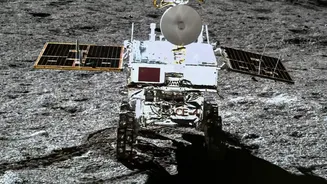
As nations like India, with its successful Chandrayaan programme, join the United States, China, and Russia in a new era of lunar exploration, the issue becomes more urgent. The focus on the Moon's south pole, a target for NASA's Artemis missions and others, is driven by the presence of water ice in permanently shadowed craters. But these are the very same regions identified as potential havens for microbial survival. As we prepare to establish long-term bases on the Moon, understanding what we bring with us is a critical part of responsible exploration. Every footprint and rover track could create a new, tiny habitat where Earth life might just be waiting for a chance to awaken. The silent, grey dust of the Moon may be hosting some very patient, very resilient visitors from our own world.