






First, What Is Your Core?
Before you start, it’s important to know what you’re working. Your core is much more than just the “six-pack” muscles (the rectus abdominis). It’s a complex group of muscles that wraps around your entire torso, including your deep abdominals (transverse
abdominis), obliques (sides), and the muscles in your lower back and hips. Think of it as your body's central support system, responsible for stabilizing your spine and powering your movements. A strong core helps with everything from carrying groceries to improving your form in other exercises.
The Plank: Your Foundation
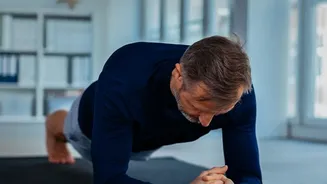
The plank is a fundamental exercise for a reason: it engages your entire core safely and effectively. It’s an isometric hold, meaning you brace your muscles without moving.
How to do it: Lie face down and prop yourself up on your forearms and toes, keeping your body in a straight line from your head to your heels. Your elbows should be directly under your shoulders. Engage your abs by pulling your belly button toward your spine, and squeeze your glutes. Avoid letting your hips sag or rise too high. For beginners, aim to hold this position for 20–30 seconds with perfect form. It’s better to hold a shorter plank correctly than a longer one with poor form.
The Glute Bridge: For a Stronger Back
A strong core includes a strong back. The glute bridge targets your glutes and lower back, crucial muscles for posture and stability that are often overlooked in beginner routines.
How to do it: Lie on your back with your knees bent, feet flat on the floor about hip-width apart, and your arms by your sides. Squeeze your glutes and abs, then lift your hips off the floor until your body forms a straight line from your shoulders to your knees. Hold for a moment at the top, then slowly lower your hips back down. Aim for 3 sets of 15 repetitions.
The Dead Bug: For Coordination and Stability
This exercise might look easy, but it’s a powerhouse for building deep core stability and coordination without putting any strain on your lower back. It teaches your core to brace while your limbs are in motion.
How to do it: Lie on your back with your arms extended toward the ceiling and your knees bent at a 90-degree angle over your hips (like an upside-down bug). Slowly lower your right arm and left leg toward the floor simultaneously, exhaling as you go. Lower them only as far as you can without your lower back arching off the floor. Return to the starting position and repeat on the other side. That’s one rep. Aim for 3 sets of 10 reps per side.
The Bird-Dog: A Test of Balance
Similar to the dead bug, the bird-dog challenges your stability, but from a different position. It’s excellent for strengthening the muscles that support your spine.
How to do it: Start on all fours with your hands directly under your shoulders and your knees under your hips. Keep your back flat and your core engaged. Extend your right arm straight forward and your left leg straight back at the same time, keeping your hips and shoulders square to the floor. Hold for a second, then return to the start. Repeat on the other side. Focus on slow, controlled movements. Aim for 3 sets of 10 reps per side.
Mountain Climbers: Adding a Dynamic Challenge
Once you feel comfortable with holds, it's time to add movement. Mountain climbers increase your heart rate while challenging your core stability. The key for beginners is to go slow and focus on form, not speed.
How to do it: Start in a high plank position, with your hands under your shoulders and your body in a straight line. Engage your core and bring your right knee toward your chest, then return it to the starting position. Immediately bring your left knee toward your chest. Continue alternating legs in a steady, controlled rhythm. Imagine you’re running in place slowly. Start with 30 seconds and build up from there.