




Darjeeling Himalayan Railway: The Original Toy Train
A journey on the Darjeeling Himalayan Railway is like stepping back in time. This narrow-gauge line, affectionately known as the 'Toy Train', has been chugging through the misty hills of West Bengal since 1881. As a UNESCO World Heritage site, its charm
is legendary. The train slowly winds its way up from the plains, navigating sharp curves and ingenious loops, like the famous Batasia Loop, to gain altitude. Pulled by a vintage steam or diesel locomotive, the carriages offer breathtaking views of emerald tea plantations and, on a clear day, the snow-capped peak of Kanchenjunga. This isn't just a train ride; it's an encounter with living history and a tribute to pioneering engineering against a stunning Himalayan backdrop.
Kalka-Shimla Railway: Tunnels and Vistas
Built in 1903 to connect the summer capital of British India, the Kalka-Shimla Railway is another UNESCO World Heritage gem that showcases incredible engineering. The 96-kilometre route climbs over 1,400 metres, navigating a staggering 919 curves, 864 bridges, and 102 active tunnels. The journey is a slow, rhythmic passage through the serene Shivalik Hills, offering panoramic views of pine forests and quaint hillside villages. Each tunnel passed is a milestone, with the longest, the Barog Tunnel, stretching over a kilometre. The train itself, with its classic coaches, provides a nostalgic experience as it dutifully makes its ascent to the bustling hill station of Shimla, making the journey as memorable as the destination itself.
Nilgiri Mountain Railway: Asia’s Steepest Climb
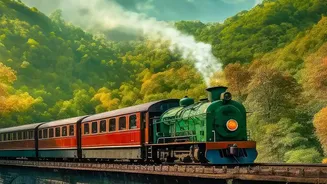
Deep in the rolling Blue Mountains of Tamil Nadu lies a truly unique feat of railway engineering: the Nilgiri Mountain Railway. What makes this UNESCO-listed line stand out is its use of a rack and pinion system, the only one of its kind in India. This 'cogwheel' technology allows the train to grip the track and ascend Asia's steepest railway gradient, a challenge conventional trains could never overcome. The 46-kilometre journey from Mettupalayam to Ooty is a feast for the senses, passing through 16 tunnels, over 250 bridges, and past dense forests, waterfalls, and sprawling tea estates. The sight of the powerful steam locomotive pushing the carriages uphill is an unforgettable part of this enchanting experience.
Konkan Railway: A Modern Coastal Marvel
Shifting from heritage to modern marvels, the Konkan Railway is a testament to India's post-independence engineering prowess. Completed in 1998 after a monumental eight-year construction effort, this 741-kilometre line runs parallel to the Arabian Sea, connecting the coasts of Maharashtra, Goa, and Karnataka. The route, which the British once deemed too difficult to build, cuts through the rugged Sahyadri mountains. To achieve this, engineers built nearly 2,000 bridges and bored through 92 tunnels, including what was once India's longest. The journey offers a spectacular, fast-paced contrast of landscapes, from lush green valleys and paddy fields on one side to the glistening sea on the other, showcasing the beauty of India's western coastline.
The Kashmir Line: Reaching New Heights
Representing the cutting edge of Indian engineering, the Jammu-Udhampur-Srinagar-Baramulla Rail Link (USBRL) is a project of national importance. Its crowning glory is the Chenab Rail Bridge, the world's highest railway bridge, soaring 359 metres above the riverbed—taller than the Eiffel Tower. This steel arch bridge is an icon of modern India, designed to withstand extreme temperatures and high wind speeds in the geologically complex Himalayas. The line also features India's first cable-stayed railway bridge over the Anji Khad. While the entire route connects the Kashmir Valley with the rest of the country, the bridges themselves are breathtaking symbols of ambition, connecting communities and overcoming some of the most challenging terrains on Earth.