







A Landmark Launch
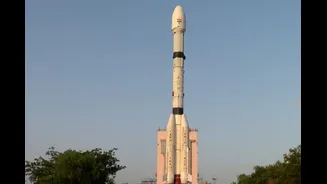
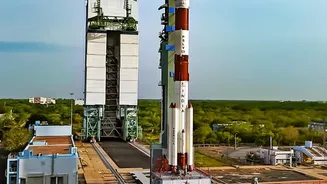
On September 4, 2026, ISRO's Geosynchronous Satellite Launch Vehicle (GSLV-F17) successfully lifted off from the Satish Dhawan Space Centre in Sriharikota. Its primary passenger was the 2,367-kg EOS-05 satellite, which it placed into a sub-geosynchronous
transfer orbit. The satellite is now using its own propulsion to make the journey to its final destination: a geosynchronous orbit (GEO) approximately 36,000 kilometres above the Earth. This mission is a significant success for the GSLV rocket, which once had a reputation for being unreliable, proving its capability to deliver heavy payloads to high orbits. More importantly, it delivered a satellite that gives India a capability it has never had before.
The Power of a Fixed Gaze
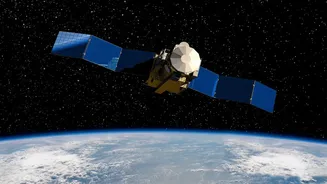
The true milestone of EOS-05 lies in its orbit. Most Earth-imaging satellites operate in Low-Earth Orbit (LEO), circling the planet and only passing over a specific location periodically. In contrast, a satellite in geosynchronous orbit matches the Earth's rotation, allowing it to remain fixed over the same broad region continuously. This transforms Earth observation from taking periodic snapshots to maintaining a persistent watch. EOS-05 is India’s first imaging satellite designed for this unique vantage point. From its high perch, it is designed to be able to image the entire Indian landmass roughly every 30 minutes, and can be tasked to focus on specific areas of interest as frequently as every five minutes, providing an unprecedented rate of updates.
A Game-Changer for Disaster Management
This ability to provide near-real-time imagery is expected to revolutionize how India manages natural disasters. For events that develop rapidly, like cyclones, floods, landslides, and forest fires, EOS-05 can provide a constant stream of data. Authorities will be able to track the movement of a cyclone's cloud systems, see the spread of floodwaters in real-time, and monitor a wildfire's path, enabling faster warnings and more effective emergency responses. Beyond disasters, the satellite's advanced multi-spectral and hyperspectral imagers will provide vital data for agriculture, monitoring crop health and water resources, as well as tracking environmental changes.
An Eye on National Security
The applications of EOS-05 are not purely civilian. The satellite is a dual-use asset with significant strategic implications. Its capacity for persistent monitoring provides a powerful new tool for national security, allowing for surveillance of India’s vast land borders and maritime zones. Unlike satellites that pass over a border region for only a few minutes each day, EOS-05 can maintain a constant watch, detecting changes and providing a valuable layer of intelligence. While officials have noted it is not a dedicated spy satellite, its capabilities offer a strategic advantage in monitoring areas of interest and critical infrastructure.
A Mission of Redemption
The success of EOS-05 is also a story of resilience for ISRO. The mission effectively achieves the goals of the EOS-03 satellite, which was lost in a launch failure in August 2021 due to an anomaly with its GSLV rocket. This successful launch five years later demonstrates ISRO's ability to overcome technical setbacks. By placing its heaviest satellite yet into the correct orbit, the GSLV has cemented its role as a reliable heavy-lift launcher for India's most ambitious space projects. The successful deployment of this advanced geo-imaging satellite marks a triumphant moment, fulfilling a long-held ambition for the Indian space programme.