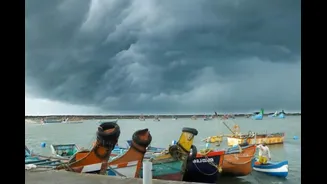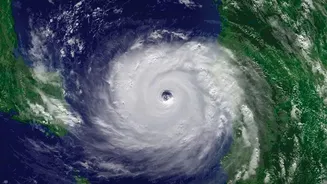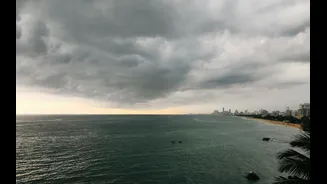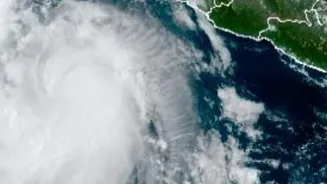






For India's cyclone-prone coasts, every hour of accurate warning is critical. Now, a breakthrough in artificial intelligence called WeatherNext is showing remarkable progress in predicting not just a cyclone's path, but its internal wind structure.
A New Era in Cyclone Forecasting
For
decades, forecasting a cyclone's path has steadily improved, but predicting its intensity and internal structure has remained a major challenge. Traditional models often struggled to resolve the fine-scale dynamics within a storm's core that dictate its destructive power. This is where WeatherNext, an AI model developed by Google DeepMind, represents a significant leap forward. In research published in the journal Nature, the model demonstrated an ability to predict a cyclone's track, intensity, and wind structure with unprecedented accuracy, effectively adding an extra day of reliable warning time. A three-day forecast from WeatherNext is now as accurate as previous two-day forecasts, an advance that experts say is equivalent to a decade of progress.
Why Wind Structure Is a Game-Changer
Knowing where a cyclone will make landfall is only half the battle. The 'wind structure' provides crucial details about the storm's anatomy: the size of the eyewall, the radius of its maximum winds, and how far its damaging winds extend. This information is vital for disaster management authorities to issue precise warnings. An accurate wind structure forecast helps predict the extent of storm surge, identifies which specific areas will face the strongest winds, and allows for more targeted evacuations. Previously, forecasters often had to choose between models that were good at predicting a storm's track and separate, computationally expensive models for intensity. WeatherNext bridges this gap, handling all three aspects—track, intensity, and structure—within a single, unified AI system.
How the AI Model Works
Instead of relying on traditional physics-based calculations that are incredibly complex and require immense computing power, WeatherNext uses AI to learn from vast amounts of historical data. The model was trained on global weather patterns and a database of nearly 5,000 historical storms. This allows it to recognize complex patterns that precede changes in a cyclone's behavior. One of its most powerful features is 'ensemble forecasting'. The system can generate 1,000 possible scenarios for a single storm in under a minute, a massive increase from the roughly 50 scenarios generated by older models. This allows forecasters to see a wider range of potential outcomes, including low-probability but high-impact events like rapid intensification—a sudden, dangerous increase in a storm's strength.
From Lab to Lifesaving Application
The progress shown by WeatherNext is not just theoretical. During the 2025 Atlantic hurricane season, the model helped the U.S. National Hurricane Center predict the rapid intensification and landfall of Hurricane Melissa, leading to earlier warnings that gave communities critical time to prepare. For India, which has seen devastating cyclones like Biparjoy in 2023 and Yaas in 2021, the implications are enormous. The India Meteorological Department (IMD) has already made huge strides in its early warning systems, dramatically reducing fatalities over the past two decades. Integrating advanced AI tools like WeatherNext could further enhance these capabilities, providing more precise and timely alerts to vulnerable coastal populations along the Bay of Bengal and the Arabian Sea.
The Future of Forecasting
While the results are promising, AI in weather forecasting is still an evolving field. Some meteorologists note the 'black box' nature of these models; they are incredibly accurate at predicting an outcome, but it's not always clear why they made a specific prediction. Despite this, the consensus is that AI is a powerful new tool that complements, rather than replaces, human expertise. Recognizing the global importance of this technology, Google has made its WeatherNext models open source. This allows researchers and meteorological agencies around the world, including in India, to experiment with the technology, adapt it to local conditions, and potentially integrate it into their own forecasting systems, heralding a new, more resilient future for cyclone preparedness.