







A Rover's Journey Through Time
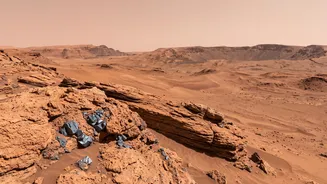
Since landing in Gale Crater in 2012, NASA's Curiosity rover has acted as a robotic geologist on a mission through time. The 96-mile-wide crater is home to Mount Sharp, a towering, 5-kilometre-high mountain made of layered rock. These layers are like
pages in a history book; the lower down the rover explores, the further back in time it sees. As Curiosity slowly climbs the mountain, it drills into these layers, collecting powdered rock samples. Instruments inside the rover, like the Chemistry and Mineralogy (CheMin) tool, analyze this powder, giving scientists on Earth an unprecedented look at the chemical makeup of Mars from billions of years ago. This work has already confirmed that ancient Mars had key ingredients necessary to support microbial life, including sulfur, nitrogen, oxygen, and carbon.
Reading the Story in the Rocks
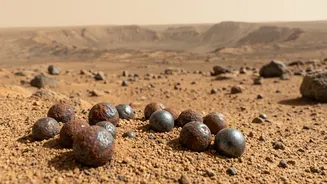
The latest discoveries hinge on reading subtle clues within the rocks. One recent study, published in August 2026, focuses on a rust-coloured mineral called hematite. Scientists found that the tiny crystals making up hematite change in size and structure depending on the environment in which they formed. By analyzing samples from different elevations on Mount Sharp, the team could trace changes in Mars' ancient climate. Deeper, older layers contained hematite crystals suggesting they formed in the presence of warm water over long periods. This implies that even as the Martian surface began to cool and dry out, warm groundwater could have persisted underground for millions of years, potentially creating habitable pockets shielded from the harsh surface.
Evidence of Earth-Like Cycles
Perhaps the most exciting finding is evidence not just of water, but of repeating wet-dry cycles, much like seasons on Earth. In 2021, Curiosity discovered a distinctive hexagonal pattern of ancient mud cracks. While simple, straight cracks indicate a single period of drying, these complex hexagonal shapes only form when mud is repeatedly exposed to water and then dries out over and over again. This is the first tangible evidence that ancient Mars had a regular, sustained climate of wet and dry spells. These cycles are considered crucial by some scientists for the origin of life, as they can concentrate the chemical building blocks and drive the reactions that could lead to the formation of complex organic molecules.
Solving the Missing Carbon Puzzle
For Mars to have been warm enough to support liquid water, its ancient atmosphere would have needed to be thick with carbon dioxide. For years, scientists were puzzled because orbital surveys and previous rovers hadn't found the large carbonate mineral deposits that a CO2-rich atmosphere should have created. Curiosity may have solved this mystery. By drilling beneath the surface, it discovered significant amounts of a carbonate mineral called siderite. The finding suggests these minerals were there all along but were masked from satellite detection by other minerals. This discovery confirms that Mars once had an active carbon cycle, with the atmosphere and surface rocks exchanging carbon, a critical process for maintaining a planet's climate and habitability.