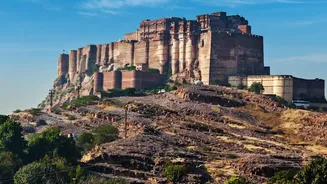


Mehrangarh Fort: The Citadel of the Sun
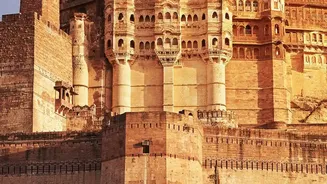
Dominating the skyline of Jodhpur, Mehrangarh Fort rises from a 122-metre-high rocky cliff, a formidable structure that Rudyard Kipling called 'the work of giants'. Founded in 1459 by Rao Jodha, the fort's massive walls enclose a complex of exquisite
palaces, including the Moti Mahal (Pearl Palace) and Phool Mahal (Flower Palace). Its ramparts offer breathtaking views of Jodhpur’s famous blue houses, anchoring this fortress firmly in the stark, sun-drenched landscape of Marwar.
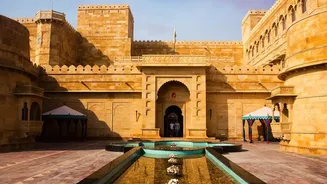
Jaisalmer Fort: The Golden Living Fortress
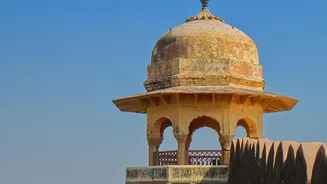
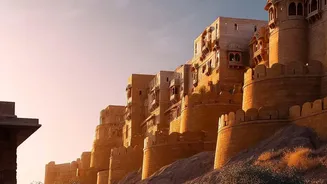
Emerging like a mirage from the Thar Desert, Jaisalmer Fort is a unique marvel. Built in 1156 from yellow sandstone, it glows with a honey-gold hue at sunset, earning it the name 'Sonar Quila' or Golden Fort. What makes it truly distinct is that it remains a “living fort,” with thousands of people residing within its ancient walls. Its narrow, winding lanes are filled with homes, shops, and temples, offering a rare glimpse into a medieval citadel that is still very much alive.
Amber Fort: The Hillside Palace of Mirrors
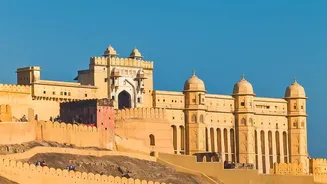
Set against the rugged Aravalli Hills and overlooking Maota Lake, Amber Fort near Jaipur is a stunning blend of Rajput and Mughal architectural styles. Built in the 16th century from red sandstone and white marble, its grandeur is revealed through a series of four courtyards. The fort is famous for the Sheesh Mahal (Mirror Palace), where intricate mirror work covers the walls and ceilings, creating a dazzling spectacle of reflected light that epitomises royal opulence.
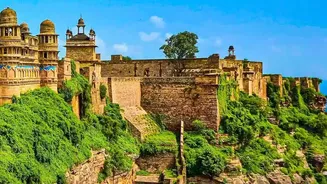
Gwalior Fort: The Gibraltar of India
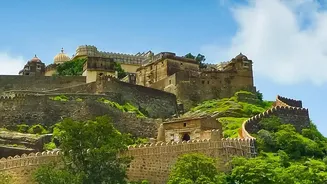
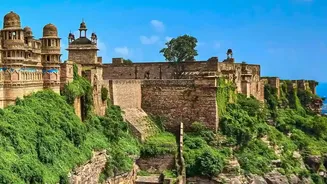
Perched on a long, steep plateau, Gwalior Fort has been a strategic stronghold in central India for over 1,500 years. Dubbed the 'pearl among the fortresses of Hind' by Mughal emperor Babur, its history is a chronicle of warring dynasties. The fort complex is vast, housing palaces, temples, and water reservoirs. Its formidable defensive walls and multi-layered gateways secured its reputation as one of India’s most unconquerable forts, a true sentinel of the northern plains.
Golconda Fort: The Diamond Capital of the Deccan
Once the capital of the Qutb Shahi dynasty, Golconda Fort in Hyderabad was a center of the global diamond trade. Originally a mud fort, it was transformed into a massive granite fortress between the 14th and 17th centuries. It is renowned for its ingenious acoustics; a clap at the main gate can be heard at the highest point of the citadel, nearly a kilometre away, a feature designed for defence. The fort's ruins speak of a time when it was a hub of immense wealth and power on the Deccan Plateau.
Daulatabad Fort: The Unconquerable Hill Fortress
Carved from a single 200-meter-high conical rock, Daulatabad Fort in Maharashtra is a masterpiece of military engineering. Originally known as Devagiri, its defences were designed to be almost impenetrable. Attackers had to navigate a labyrinth of defences, including a deep moat, spiked gates, and a confounding dark, spiralling tunnel known as the Andheri. The fort's sheer vertical sides and clever design make it a stunning example of how landscape can be transformed into an unconquerable stronghold.
Bekal Fort: The Keyhole on the Coast
Stretching across a headland on Kerala's Malabar Coast, Bekal Fort offers a dramatic seascape. It is the largest and best-preserved fort in the state, built in the mid-17th century primarily for defence. Shaped like a giant keyhole, its massive laterite walls are constantly battered by the waves of the Arabian Sea. Unlike other forts filled with palaces, Bekal was a pure military station, with its observation towers providing panoramic views of the coastline, making it a crucial guardian of the sea routes.