

The Challenge of Finding Your Way on the Moon
For as long as humanity has ventured into space, navigation has depended on a conversation with Earth. On the Moon, this is especially true. There is no existing GPS network orbiting the Moon, which means every spacecraft, lander, and rover has traditionally
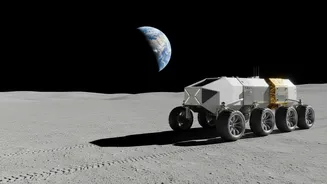
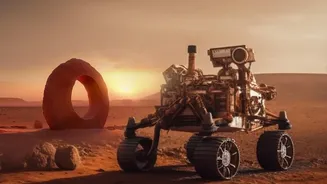
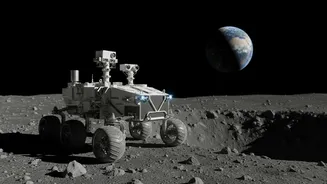
relied on the Deep Space Network — massive radio antennas on Earth — to determine its position. This method works, but it has significant limitations. There's a time delay for signals to travel back and forth, and it requires a direct line of sight to Earth. If a rover goes into a crater or behind a mountain, it's effectively flying blind. For future long-term missions under the Artemis program, which envision a bustling Moon Base with rovers and astronauts working far from their landing sites, this dependency is a major bottleneck. To build a sustainable presence, the Moon needs to become more self-sufficient.
A 'GPS' Signal from 400,000 Kilometres Away
NASA's ingenious solution is not to build a whole new satellite network around the Moon, but to use the ones we already have around Earth. The agency, in partnership with the Italian Space Agency (ASI), developed the Lunar GNSS Receiver Experiment, or LuGRE. This payload is essentially a highly sensitive receiver designed to do something that was once thought impossible: pick up the faint whispers of Earth's Global Navigation Satellite System (GNSS) signals, like GPS and Europe's Galileo, all the way at the Moon. The signals that our phones use are not designed to reach the Moon; they are pointed at Earth. But some of that signal spills out from the sides of the satellites' broadcast cones. LuGRE's special receiver and high-gain antenna are sensitive enough to detect these extremely weak, stray signals and use them to calculate a position.
Proof of Concept: The LuGRE Mission Success
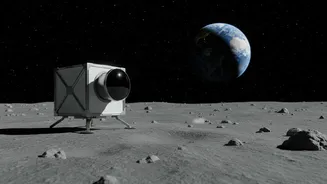
The LuGRE payload flew aboard Firefly Aerospace's Blue Ghost lander as part of a Commercial Lunar Payload Services (CLPS) mission. The experiment was a resounding success. In early 2025, during its journey and on the lunar surface, LuGRE successfully acquired signals from both GPS and Galileo satellites and calculated a navigation fix, proving that Earth's navigation systems could be used for positioning on the Moon. This was the first time this had ever been demonstrated, setting a record for the most distant GNSS fix ever achieved. The success of LuGRE has paved the way for the operational use of this technology, shifting it from a fascinating experiment to a practical tool for future lunar missions.
Next Steps: NavCube and a Networked Moon
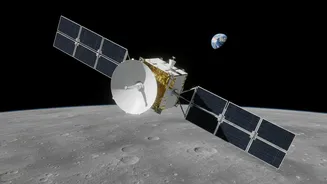
Building on LuGRE's success, NASA is advancing this technology with payloads like the NavCube3-mini. This compact and powerful receiver, about the size of a shoebox, is designed for integration into lunar relay satellites. Companies like Intuitive Machines plan to launch a network of these satellites, creating a lunar data and navigation network called LunaNet. One such satellite, Altus-1, is scheduled to launch in late 2026 and will carry the NavCube3-mini to demonstrate its capabilities in lunar orbit. This network will provide continuous communication and navigation support for missions, especially in challenging areas like the lunar South Pole where direct contact with Earth is often blocked.
Unlocking a New Era of Lunar Exploration
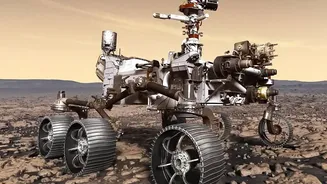
The ability for rovers and astronauts to navigate autonomously without constant communication with Earth is a game-changer. It means rovers can explore farther and more safely, mapping new territory and searching for resources like water ice. Astronauts will have a reliable way to know their precise location during extra-vehicular activities (EVAs), dramatically increasing safety. This technology is a critical piece of the puzzle for establishing a permanent Moon Base, as it enables the complex logistics of construction, resource transportation, and scientific exploration. By enabling this new level of autonomy, NASA and its commercial partners are not just improving navigation; they are laying the essential groundwork for a sustained human and robotic presence on the Moon.