




A Cosmic Ghost Story
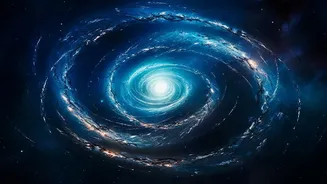
Imagine a crime scene that is 10 billion years old. The culprit was a massive, incoming dwarf galaxy, and the victim was our own Milky Way, which was then in its infancy. In a cataclysmic, head-on collision, the smaller galaxy was torn to shreds and consumed.
For decades, astronomers suspected such a massive merger event had occurred, but the evidence was scattered across the sky. This ancient collision, one of the most significant events in our galaxy's history, didn't just add new stars; it fundamentally reshaped the Milky Way's destiny. The absorbed galaxy was enormous, possessing a mass more than 10 billion times that of our sun. Its violent demise left behind a ghostly trail of evidence that scientists are only now beginning to fully comprehend.
The Galactic Detective Agency
The primary detective in this cosmic case is the European Space Agency's Gaia satellite. Launched to create the most precise three-dimensional map of the Milky Way, Gaia has been tracking the positions, movements, and chemical compositions of billions of stars. In 2018, this data revealed a population of stars moving in strange, elongated orbits, plunging towards and away from the galactic center. When astronomers plotted their velocities, the resulting shape resembled a sausage, leading them to nickname the obliterated galaxy the "Gaia-Sausage." More formally known as Gaia-Sausage-Enceladus (GSE), the peculiar orbits of its remnant stars are the smoking gun—a clear sign that they are outsiders, debris from a long-dead galaxy still haunting the Milky Way.
A Galaxy Flipped On Its Side
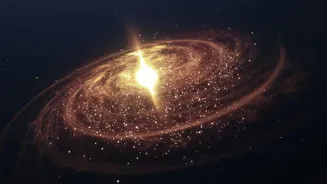
The headline discovery, presented in July 2026, is that this ancient collision likely did more than just add stars—it may have flipped the entire galactic disk. Using supercomputer simulations, astronomers at Durham University sought to explain a long-standing puzzle: why the stars in the Milky Way's vast, spherical halo rotate so slowly. The main disk of our galaxy spins at around 220 kilometers per second, but the halo stars barely creep along at 10 to 20 kilometers per second. The simulations showed that when a Milky Way-like galaxy suffers a massive, head-on collision like the one with Gaia-Sausage, the resulting gravitational chaos can cause the entire disk to gradually tilt and reorient itself by more than 90 degrees over hundreds of millions of years. This cosmic flip would explain the halo's sluggish rotation.
Echoes of a Violent Past
The effects of this 10-billion-year-old event are not just historical footnotes. The sheer violence of the merger is believed to have triggered a massive wave of star formation and created the central bulge of our galaxy. The debris from the Gaia-Sausage makes up a significant portion of the Milky Way's stellar halo, the sparse cloud of ancient stars that envelops the main disk. Researchers believe the collision's immense gravitational influence is still echoing through the galaxy. It created a "warp" in the galactic disk and its ongoing effects help astronomers understand the distribution and behavior of dark matter, the invisible substance that makes up most of the galaxy's mass.
Why This Ancient Crash Still Matters
Understanding this ancient crash provides a crucial window into how large spiral galaxies like ours are built. It confirms that galactic formation is not a gentle process but a chaotic history of cannibalism and collision. By studying the chemical fingerprints of the Gaia-Sausage stars, astronomers can even reconstruct what the progenitor galaxy was like before it merged. These findings demonstrate that our galaxy is a dynamic, evolving entity. Even our own sun's stable position might not have been so stable throughout its entire lifetime had the galaxy's orientation shifted so dramatically. The Milky Way is still absorbing smaller galaxies today, like the Sagittarius dwarf galaxy, but none are as massive as the Gaia-Sausage was. Therefore, that ancient collision remains the last truly transformative event in our galaxy's life.