






A Colossal Ocean on a Giant Moon
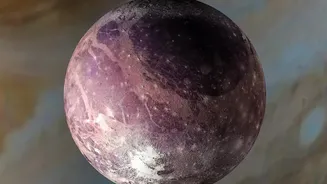
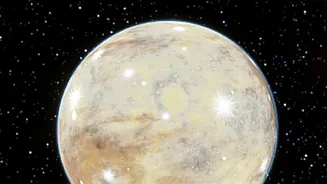
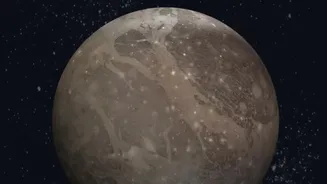
Ganymede is a world of superlatives. Not only is it the largest moon in our entire solar system—bigger than the planet Mercury—it is also the only moon known to have its own magnetic field. But its most staggering feature lies hidden. Buried beneath a thick
crust of ice, estimated to be about 150 kilometres thick, is a vast, global ocean. Scientists calculate this ocean is around 100 kilometres deep. To put that in perspective, Earth's oceans have an average depth of just 3.7 kilometres. This immense volume means Ganymede likely holds more water than all of Earth's oceans combined.
How Can We See a Hidden Ocean?
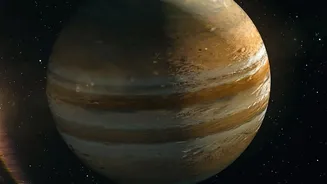
So, how do you detect an ocean you can't see, hundreds of millions of kilometres away? The secret lies in a celestial light show: aurorae. Like Earth, Ganymede has aurorae—glowing ribbons of gas near its poles—created by its magnetic field. However, Ganymede is also embedded within Jupiter's much more powerful magnetic field. As Jupiter rotates, its magnetic field washes over Ganymede, causing the moon's aurorae to 'rock' back and forth. Scientists using the Hubble Space Telescope observed this rocking motion. If Ganymede were solid ice and rock all the way through, the aurorae would be expected to shift by about six degrees. Instead, Hubble observed a much smaller shift of only two degrees. The best explanation is a huge, electrically conductive layer beneath the surface acting as a drag. That layer is a global ocean of salty water.
A 'Club Sandwich' of Ice and Water
This isn't your typical ocean. The immense pressures inside Ganymede create conditions unlike anywhere on Earth. While the ocean is sandwiched below a surface crust of ice, it may not sit directly on a rocky floor. Under such extreme pressure, water can form different, denser phases of ice—types of ice that would actually sink rather than float. Some models suggest Ganymede’s interior could be a 'club sandwich' of alternating layers of ice and liquid water stacked on top of one another. Initially, this was thought to be bad news for the possibility of life, as it would prevent water from interacting with a rocky seabed, a key ingredient for developing life as we know it. However, newer models that factor in salts suggest that some layers of liquid might be dense enough to sink all the way down to the moon's rocky mantle, creating that crucial water-rock interface.
Could Anything Live There?
The discovery of a vast, saltwater ocean that might be in contact with rock naturally raises one of the most exciting questions in science: could it harbour life? While the surface of Ganymede is frigid, with temperatures dropping to -171 degrees Celsius, its interior is warmed by tidal forces from Jupiter and the decay of radioactive elements in its core. This warmth could keep the ocean liquid and potentially power hydrothermal vents on the seafloor, similar to the vents on Earth's ocean floors where entire ecosystems thrive without sunlight. The presence of salts and organic molecules, which have been detected on Ganymede's surface and likely originated from the ocean, further boosts its potential habitability. While there is no direct evidence of life, the right ingredients appear to be present.
A Closer Look Is Coming
The secrets of Ganymede’s ocean won’t remain hidden forever. The European Space Agency’s (ESA) Jupiter Icy Moons Explorer (JUICE) mission, which launched in 2023, is on its way to the Jupiter system. After arriving in 2031, JUICE will perform numerous flybys of Ganymede before becoming the first spacecraft in history to orbit a moon other than our own. Its instruments will measure the moon's magnetic field, map its icy crust, and analyse its composition in unprecedented detail, providing our best-ever understanding of this enormous, hidden water world. The mission aims to confirm the ocean's depth and properties, bringing us one step closer to knowing what lies within the solar system's largest ocean.