





The 'Mother of Hubble'
Long before a telescope carried her name, Nancy Grace Roman was a foundational force at NASA. As the agency's first Chief of Astronomy and its first female executive, she was a trailblazer in every sense. Roman, who passed away in 2018, is often called
the 'Mother of the Hubble Space Telescope' for her tireless work in the 1960s and 70s to make the concept a reality. She championed the idea of putting observatories above Earth's distorting atmosphere, bringing together scientists and engineers to turn a visionary idea into a tangible, funded project. Her role involved not just planning, but persuading Congress and the scientific community that this was a necessary leap forward for humanity's understanding of the cosmos.
A Panoramic View of the Cosmos
The Roman Space Telescope, scheduled for launch on August 30, 2026, is an evolution of the principles Roman herself established. While it has a primary mirror the same size as Hubble's (2.4 meters), its power lies in its extraordinary field of view. Its Wide Field Instrument can capture an area of the sky at least 100 times larger than Hubble can in a single snapshot. Imagine trying to photograph a vast landscape. While Hubble might take 100 individual, high-resolution photos to capture the scene, Roman can take a single, equally detailed panoramic shot. This incredible efficiency will allow it to map huge swaths of the universe, creating unprecedented cosmic atlases.
Hunting for Cosmic Mysteries
This wide, deep view is purpose-built for tackling some of the biggest questions in astrophysics. Roman has two primary objectives: to study dark energy and to discover exoplanets. Dark energy is the mysterious force believed to be causing the accelerated expansion of the universe. By surveying billions of galaxies, Roman will measure how their distribution and the expansion rate have changed over cosmic time, providing crucial clues about this force's nature. For exoplanets, Roman will conduct a massive survey using a technique called microlensing. This method can detect planets with a wide range of masses and orbits, including worlds much farther from their stars than Earth is from the Sun, helping complete our census of planetary systems in the galaxy.
More Than a Single Mission
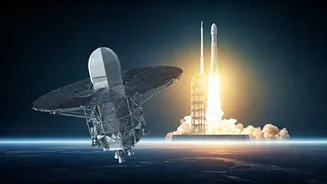
Beyond its core surveys, the Roman telescope is a versatile observatory for the entire astronomical community. Its Coronagraph Instrument is a technology demonstration designed to directly image giant exoplanets by blocking out the overwhelming light of their host stars. This technology is a critical stepping stone for future missions that could one day image Earth-like planets. Furthermore, Roman’s data on billions of stars and galaxies will be a treasure trove for scientists studying everything from the evolution of galaxies and supermassive black holes to small bodies within our own solar system. Having recently arrived at Kennedy Space Center for final launch preparations, the telescope is poised to begin its five-year primary mission, operating from the second Sun-Earth Lagrange point (L2), about 1.5 million kilometers from Earth.