

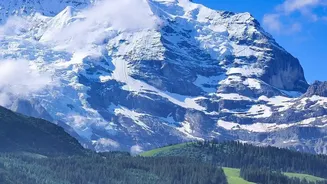


The New Height on the Roof of Europe
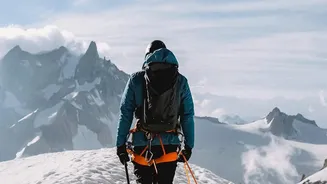
A team of French surveyors announced on October 14, 2026, that Mont Blanc now stands at 4,807.47 metres. This is a significant increase of 1.88 metres from the measurement taken in 2023, which was 4,805.59 metres. The measurement is conducted every two
to three years by experts from the Haute-Savoie regional administration to build a model of the mountain's ice cap and track its evolution. This year's expedition involved a team of surveyors, scientists, and guides who ascended the peak on September 17, hauling nearly 30 kilograms of high-tech gear to spend two hours taking precise readings at the summit.
Why the Fluctuation? It's All in the Snow
Before you imagine the Alps undergoing a sudden growth spurt, it's important to understand what is actually being measured. The rock summit of Mont Blanc is stable at around 4,792 metres above sea level. The variation comes from the thick, permanent dome of ice and snow that sits on top. This snowy crown changes in height and volume depending on weather conditions. The amount of precipitation during the year and the strength of high-altitude winds are the primary factors. Heavier winter and summer snowfall can add to the cap, while strong winds can blow snow off the summit, compact it, or redistribute it. This is why the height is in constant flux; in 2023, the mountain actually shrank by more than two metres compared to its 2021 measurement.
The Science of a High-Altitude Survey
Measuring a mountain like Mont Blanc is a complex operation. The surveyors use high-precision GPS technology, planting receivers on the summit that record satellite signals. These signals are then corrected to provide accuracy down to the centimetre. For the first time in recent surveys, the team also used a drone to capture over 1,300 images, helping to create a detailed 3D model of the snow and ice cap. Additionally, ground-penetrating radar is used to probe the thickness of the ice and determine where the solid rock beneath it begins. This biennial data collection, which began in 2001, provides crucial information for glaciologists and other scientists.
A Barometer for Weather, Not a Climate Reversal
It might be tempting to see a 'taller' Mont Blanc as good news in the face of climate change, but experts caution against such conclusions. Chief surveyor Jean des Garets emphasized that these fluctuations are normal and that a single measurement is not significant on its own. He stated that 'Mont Blanc could well be much taller in two years' or shorter, depending on the weather patterns. Glaciologists clarify that the summit's changes reflect short-term weather phenomena, not a reversal of the long-term trend of melting glaciers at lower altitudes in the Alps. In fact, many glaciers in the region have visibly retreated. The data is collected for future generations, allowing scientists to analyse long-term trends and distinguish between yearly weather variations and the deeper impact of climate change.