







A Look Inside Our Planet
To understand this event, we first need a quick tour of our planet's interior. Earth is made of several layers. We live on the crust, but far below lies the core, separated into two parts. The inner core is a solid ball of iron and nickel, while the outer
core is a superheated ocean of liquid iron and nickel that churns and swirls. This motion of electrically conducting liquid, roughly 2,200 kilometres below the surface, is incredibly important; it acts like a giant dynamo, generating the magnetic field that protects our planet.
How Scientists Track the Core
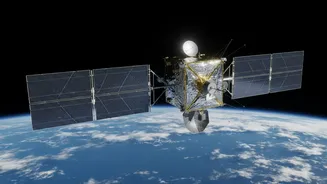
Since we can't drill down to the core, scientists rely on indirect methods to study its behaviour. By using a network of ground-based observatories and sophisticated satellites—like the European Space Agency's Swarm mission—researchers can measure tiny fluctuations in the Earth's magnetic field. These variations act as clues, allowing them to map the flow of the molten iron below. For decades, these measurements showed that the outer core's flow was dominated by a general westward drift.
The Unexpected Reversal
Around 2010, scientists noticed something had changed dramatically. A large region of the molten core deep beneath the equatorial Pacific Ocean, which had been flowing weakly westward, abruptly switched direction and began moving strongly eastward. This reversal was a surprise, challenging the long-held assumption that the core's large-scale circulation was a relatively stable system. The event showed that changes in the deep Earth can happen much more rapidly than previously thought, within just a decade.
Why This Deep-Earth Drama Matters
While these events happen too deep to pose any direct threat to us on the surface, they are fundamental to understanding how our planet works. The outer core's flow generates Earth's magnetic field, which acts as a vital shield against harmful solar radiation from the Sun. Without this protective bubble, our atmosphere could be stripped away, and our technological infrastructure, from navigation systems to power grids, would be highly vulnerable. Understanding the geodynamo is key to predicting changes in our planet's magnetic shield.
An Unsolved Scientific Puzzle
The central question remains: what caused this sudden reversal? Scientists are currently exploring several possibilities. One hypothesis suggests a link to changes happening even deeper, possibly related to the solid inner core's rotation. Another idea is that this is not a permanent change but part of a long, natural cycle or oscillation that we are only now beginning to observe. Recent data suggests the eastward flow may already be weakening, which could support the theory of a temporary fluctuation. However, the exact cause is still a mystery that researchers are actively working to solve.