





More Than Just a Walk in the Park
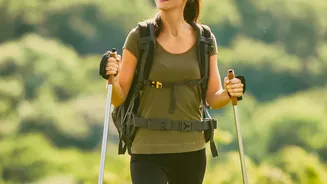
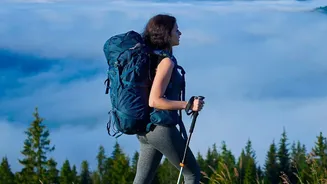
Originating in Finland as a summer training method for cross-country skiers, Nordic walking has become a global fitness phenomenon. Unlike regular walking, which primarily uses muscles below the waist, this activity incorporates specially designed poles
to actively engage the upper body. By using poles to propel yourself forward, you activate muscles in your arms, chest, shoulders, and back, transforming a simple walk into a comprehensive workout that engages between 80% to 90% of your body's muscles. This is a significant increase compared to the roughly 50% engaged during a standard walk. The result is a low-impact exercise that offers cardiovascular benefits while simultaneously building strength.
The Full-Body Benefits
The most significant advantage of Nordic walking is its efficiency. By recruiting more muscles, you burn more calories—studies show an increase ranging from 18% to as much as 67% compared to regular walking, without necessarily feeling like you're working harder. This elevated energy expenditure can contribute to reductions in fat mass and waist circumference. Furthermore, the use of poles provides added stability and can reduce the strain on lower-body joints like knees and hips, making it an excellent option for individuals with joint pain or balance concerns. Research has also linked the activity to a host of other health improvements, including better cardiovascular fitness, increased muscle strength, and even reductions in chronic pain, depression, and anxiety.
Choosing the Right Poles
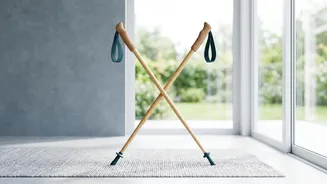
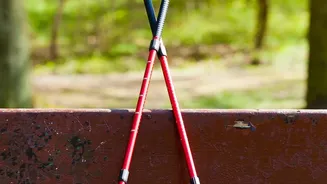
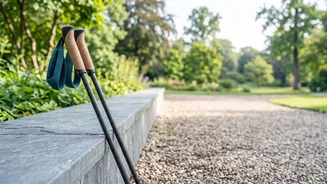
Your poles are not just accessories; they are the tools that enable the workout, so getting the right size is crucial. Poles that are too short can cause you to hunch over, while poles that are too long can strain your shoulders and make propulsion ineffective. There are two common methods for finding the correct length. The first is a simple formula: your height in centimetres multiplied by 0.68. The second method is to stand straight and hold the pole grip; your elbow should form a 90-degree angle with your forearm parallel to the ground. It is also important to choose poles designed specifically for Nordic walking, which feature a glove-like strap system, as opposed to hiking poles which have a simple loop. This special strap allows you to properly push off and propel yourself forward.
Mastering the Basic Technique
The core of Nordic walking is a natural, rhythmic movement. The fundamental pattern involves moving your opposite arm and leg forward at the same time—left arm with right leg, and right arm with left leg. Start by maintaining good posture: stand tall, look forward, and keep your shoulders relaxed. The poles should be planted between your front and back foot, angled backward. As you step forward, you plant the opposite pole and push off it to propel yourself. Your arm should swing forward from the shoulder, not the elbow. As the arm swings back, you relax your grip and open your hand, pushing through the strap to complete the movement. The goal is a smooth, gliding motion, not a jerky march.
Common Mistakes to Avoid
Beginners often make a few common errors that can reduce the effectiveness of the workout and cause discomfort. One is planting the pole too far in front of the body, which hinders propulsion and can strain joints. The correct placement is roughly midway through your stride. Another mistake is using bent elbows and not extending the arm fully during the backswing; a full arm swing from the shoulder is key to engaging the upper body muscles. Many newcomers also walk in a 'pacing' or 'amble' gait, moving the arm and leg on the same side together. To correct this, try dragging the poles behind you while walking normally to re-establish the natural opposite-arm-opposite-leg rhythm.