






The Universe's Invisible Glue
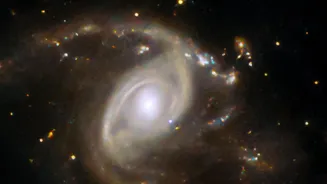
So, what exactly is this mysterious stuff? The simple answer is we don’t know. But we can see its effects everywhere we look. Scientists first inferred the existence of dark matter from the way galaxies spin. They rotate so fast that the gravity from their
visible stars and gas shouldn't be enough to hold them together; they should fly apart. The fact that they don't suggests there's extra mass—and therefore extra gravity—that we can't see. Think of it as an invisible glue holding everything together. This unseen matter doesn't seem to absorb, reflect, or emit any light, which is why it's called 'dark' and is incredibly hard to detect directly.
The Hunt for a Ghost
For decades, physicists have been trying to catch a dark matter particle. The leading candidate has long been the WIMP, or Weakly Interacting Massive Particle. The theory was elegant: if a particle with the WIMP's properties was created in the Big Bang, it would account for the amount of dark matter we observe today. To find it, scientists have built some of the most sensitive detectors ever conceived. Experiments like the LUX-ZEPLIN (LZ) detector are buried nearly a mile underground to shield them from cosmic rays and other interference. The LZ experiment uses 10 tonnes of ultra-pure liquid xenon, waiting for the tiny flash of light that would occur if a dark matter particle bumped into a xenon nucleus.
A Surprising New Signal
The headline 'no confirmed identity' doesn't quite capture the latest excitement in the field. While there is no discovery, the most recent reports from the LZ collaboration, presented in late 2026, have revealed something intriguing. In their massive dataset, they found a single, anomalous particle interaction that is difficult to explain by known background processes. Researchers are cautious, emphasizing that this is not a discovery and does not meet the '5-sigma' statistical threshold required in physics. The event has a significance of 2.6 sigma, which means there's about a 0.5% chance it could be a random background fluctuation. As LZ spokesperson Rick Gaitskell put it, 'We are not claiming to have seen dark matter. But we have seen something interesting'.
What If We're Looking for the Wrong Thing?
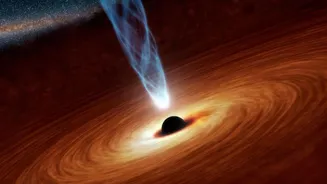
This tantalizing hint from LZ keeps the WIMP theory in play. If this event was caused by a dark matter particle, it would be a heavy one, weighing more than 200 times the mass of a proton. However, the years of searching without a definitive WIMP detection have also prompted scientists to seriously consider other possibilities. The main contenders include axions, which are extremely light, low-energy particles, and even primordial black holes, which are hypothetical black holes formed shortly after the universe began. As leading experiments continue to rule out parts of the WIMP parameter space, focus is increasingly shifting toward developing new experiments to hunt for these alternative candidates.