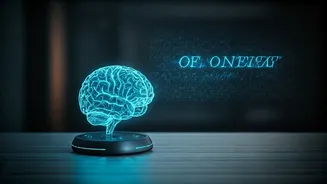










The Promise and Peril of Brain Implants
The dream of a direct link between the human brain and a computer has been a staple of science for a century. For people with paralysis or conditions that impair speech, this technology, known as a brain-computer interface (BCI), offers a life-changing
promise: the ability to communicate and interact with the world again. For years, the most significant progress came from surgical implants. Companies like Neuralink and Synchron have developed devices that are implanted in the brain or its blood vessels to read neural signals with incredible precision. These invasive methods have achieved remarkable feats, allowing patients to control cursors, play video games, and type messages just by thinking. But they come with significant risks, including the dangers of open-brain surgery, potential infection, and the long-term stability of the implant. This has largely limited their use to a small number of clinical trial participants.
A New Wave of Wearables
The next chapter in brain-to-text technology is unfolding on the outside of the head. Researchers and tech companies are making huge strides with non-invasive BCIs, typically in the form of wearable caps or headsets that can read brain activity through the skull. These devices primarily use two methods: electroencephalography (EEG), which detects the tiny electrical fields generated by firing neurons, and magnetoencephalography (MEG), which measures the corresponding magnetic fields. Another emerging technique is functional near-infrared spectroscopy (fNIRS), which uses light to track blood flow changes in the brain. While each has trade-offs in speed and accuracy, they all share a crucial advantage: no surgery required.
How Thinking Becomes Text
These wearable systems are not reading your mind in the telepathic sense. Instead, they use sophisticated AI models to detect patterns in your brain activity as you focus on a specific task. In a common setup, a user looks at a virtual keyboard, and the BCI detects their intention to select a letter, either by focusing on it or through an associated mental prompt, like attempting to move a finger. Recently, Meta announced a breakthrough with its Brain2Qwerty v2 system. Using a non-invasive MEG scanner, the system achieved a 61% average word accuracy in decoding sentences as participants were typing, a massive leap from the 8% accuracy of previous non-invasive methods. This was achieved by training powerful AI and large language models on vast amounts of brain data, allowing the system to understand context and predict words more coherently.
Closing the Gap: Speed vs. Safety
Currently, a trade-off exists between invasive and non-invasive systems. Surgical implants still offer higher performance, with some systems achieving typing speeds that rival able-bodied thumb-typing on a smartphone. However, the progress in non-invasive tech is rapidly closing that gap. For example, a company called Cognixion has reported communication speeds of up to 44 words per minute with its wearable BCI for ALS patients, a rate faster than many people text. The recent 61% word accuracy from Meta's system is another sign that the performance of non-surgical options is approaching levels once thought possible only with implants. The key takeaway is that the primary advantage is safety and accessibility. A wearable headset could potentially be used by millions of people, not just the few who qualify for and are willing to undergo brain surgery.
The Road Ahead
Despite the exciting progress, challenges remain. One of the biggest hurdles for high-performance non-invasive tech like MEG is hardware. Current MEG scanners are massive, room-sized machines, making them impractical for everyday use outside of a lab. Researchers are working on smaller, more portable sensors, but a consumer-grade 'thinking cap' is still some years away. As the technology improves and becomes more accessible, it also raises important ethical questions about data privacy and mental sovereignty. However, the immediate focus remains on the immense clinical potential: restoring the fundamental human ability to communicate for those who have lost it. By moving beyond surgery, the field is taking a critical step toward making that potential a widespread reality.