




Chand Baori, Rajasthan
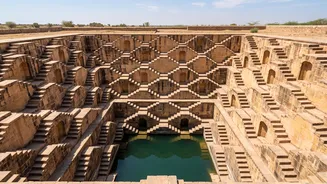
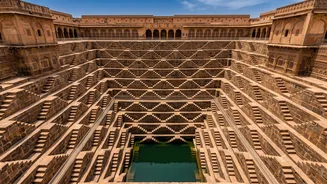
Perhaps the most visually dramatic stepwell in India, Chand Baori in the village of Abhaneri is a staggering sight. Constructed in the 8th-9th centuries, it plunges 13 stories and approximately 100 feet into the earth. Its 3,500 narrow steps are arranged
in a perfect, mesmerizing geometric pattern on three sides, creating a dizzying optical illusion. The fourth side features a multi-storeyed pavilion with carved jharokhas and galleries that were once reserved for royalty. More than a well, it was designed as a community hub, where the air at the bottom remains significantly cooler than the surface, offering a welcome escape from Rajasthan's intense heat.
Rani ki Vav, Gujarat
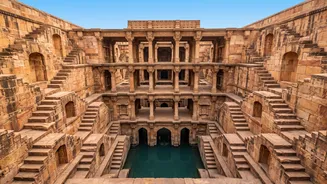
A UNESCO World Heritage Site, Rani ki Vav (the Queen's Stepwell) in Patan is a monument built out of love. It was commissioned in the 11th century by Queen Udayamati of the Chaulukya dynasty as a memorial to her husband, King Bhimdev I. Designed as an inverted temple to honor the sanctity of water, this seven-level stepwell is a masterpiece of Maru-Gurjara architecture. Its walls and pillars are adorned with over 500 principal sculptures and more than a thousand minor ones, depicting deities, celestial beings, and scenes from daily life. After being silted over by the Saraswati River, it was excavated and restored by the Archaeological Survey of India in the 1980s.
Adalaj ni Vav, Gujarat
Located near Ahmedabad, the Adalaj Stepwell tells a story of love, tragedy, and sacrifice. Its construction began in 1498 by Rana Veer Singh, but after he was killed in battle, it was completed by Sultan Mahmud Begada. The Sultan, hoping to marry the widowed Queen Rudabai, agreed to her condition of finishing the well. The five-storey structure is a stunning example of Indo-Islamic architecture, blending intricate floral and geometric patterns with Hindu and Jain symbolism. Once the well was complete, Queen Rudabai, instead of marrying the Sultan, is said to have ceremonially walked down the steps and ended her life in the water, giving the well a legendary status.
Agrasen ki Baoli, Delhi
Hidden amidst the high-rises of central Delhi near Connaught Place, Agrasen ki Baoli offers a sudden, dramatic descent into history. This protected monument, measuring 60 meters long and 15 meters wide, features 108 steps leading down to the now-dry well. While its exact origins are debated, it is believed to have been built by the legendary King Agrasen during the Mahabharata era and later rebuilt in the 14th century. Its series of stone arches and alcoves create a serene yet mysterious atmosphere, making it a popular spot for photographers and history enthusiasts seeking a quiet escape from the city's bustle.
Toorji Ka Jhalra, Rajasthan
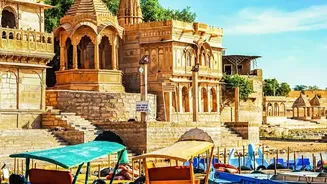
Once a neglected relic, Toorji Ka Jhalra in Jodhpur has been beautifully restored into a vibrant public space. Commissioned in the 1740s by a queen of Maharaja Abhay Singh, this stepwell is a classic example of royal women patronizing public waterworks. For years, it lay submerged and filled with debris, but a recent restoration project revealed its intricate sandstone carvings of dancing elephants, lions, and water spouts. Today, the Jhalra is a bustling hub where locals and tourists gather, with the surrounding havelis converted into cafes and boutiques, blending heritage with modern city life.
Panna Meena ka Kund, Rajasthan
Located near Amer Fort in Jaipur, Panna Meena ka Kund is a lesser-known but architecturally stunning stepwell. Believed to date back to the 16th century, this eight-storey structure is famed for its unique crisscrossing staircases that form a remarkable geometric pattern. More than just a water source in an arid region, it was a vital community gathering spot, especially for women. The symmetrical steps leading down to the water and the octagonal kiosks at its corners make it a picture-perfect example of Rajput engineering. Legends surround its origins, with some crediting a 16th-century courtier and others an earlier Meena tribal ruler.
Dada Harir ni Vav, Gujarat
Another architectural gem in Ahmedabad, Dada Harir ni Vav was completed around 1499. It was built by Dhai Harir, a superintendent of the royal harem of Sultan Mahmud Begada. This five-level stepwell is octagonal in plan and showcases a brilliant fusion of Solanki and Islamic architectural styles. Inscriptions in both Sanskrit and Arabic on its walls provide details about its construction. As one descends, the air grows cooler, and the intricately carved pillars, walls, and niches come into view. The structure's design allows for light and air to filter down to the lowest levels, making it a peaceful retreat.
Pushkarani, Hampi, Karnataka
While many famous stepwells are in western India, the Pushkaranis (sacred tanks) of Hampi in Karnataka are magnificent examples from the south. These tanks, built during the Vijayanagara Empire, were integral to temple rituals and public life. The Stepped Tank within the Royal Enclosure is particularly notable for its perfect symmetry and photogenic design. Formed from black schist stone, its tiered, pyramid-like steps are devoid of elaborate carvings but create a stunning geometric effect. Water was supplied to these tanks through an ingenious network of aqueducts, showcasing the advanced engineering of the era.