


A New Generation of Cosmic Surveyor
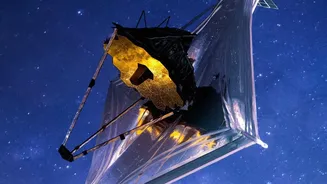
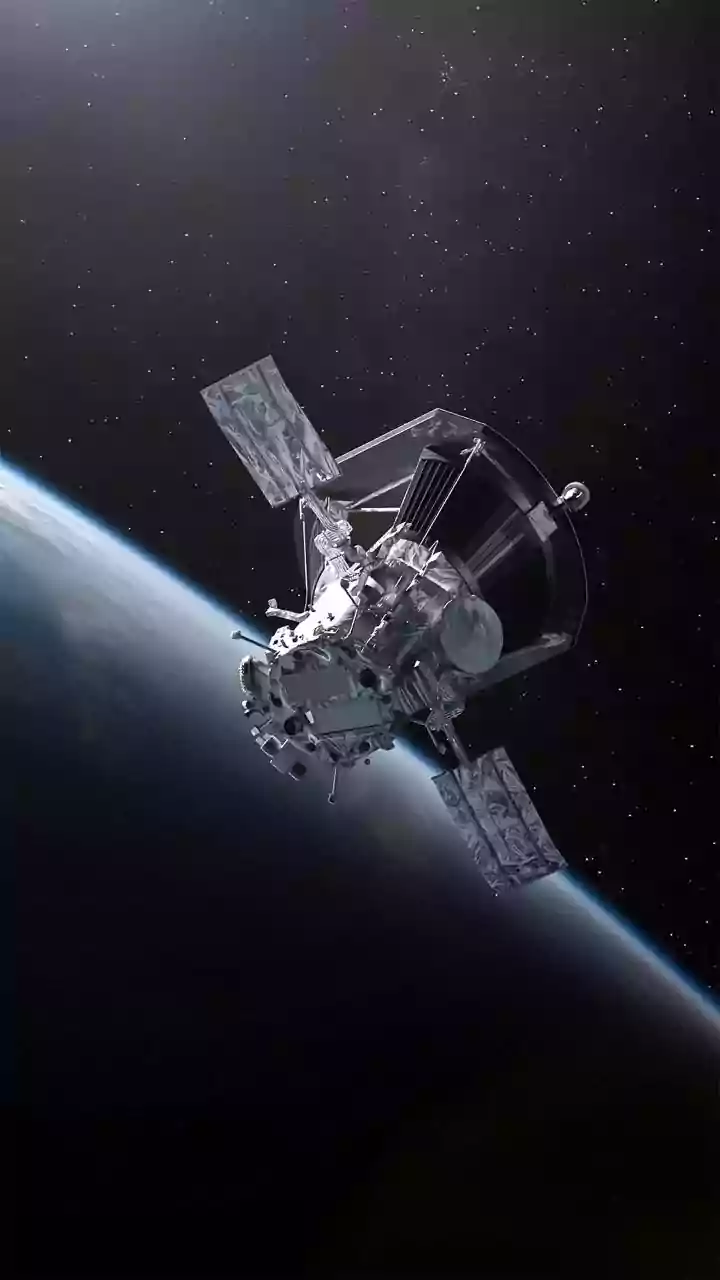
Launched in August 2026, the Nancy Grace Roman Space Telescope represents a new strategy in our quest to understand the cosmos. Named after NASA's first chief of astronomy, who championed space-based telescopes like Hubble, Roman is designed for a different
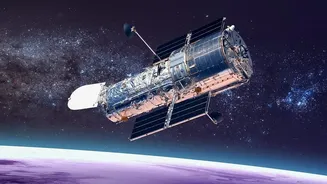
kind of seeing. While telescopes like Hubble and Webb provide exquisitely detailed close-ups of small patches of the sky, Roman’s strength is its breathtaking breadth. Its primary mirror is the same size as Hubble's at 2.4 meters, but its Wide Field Instrument gives it a field of view at least 100 times larger. This allows it to image huge swaths of the sky with the same sharp resolution, undertaking massive surveys that would take other telescopes centuries to complete.
The Power of a Panoramic View
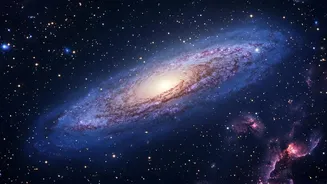
Imagine trying to understand a sprawling forest by looking through a drinking straw. You could see individual leaves in incredible detail, but you would miss the overall structure and scale of the woods. This is the challenge Roman was built to solve. Its Wide Field Instrument can capture an area of the sky 100 times larger than Hubble can in a single pointing. Where Hubble might capture the iconic 'Pillars of Creation', Roman can see the pillars and the vast star-forming nebula surrounding them all at once. This efficiency is a game-changer. The telescope is designed to survey the universe a thousand times faster than Hubble, collecting vast amounts of data that will create an unprecedented map of stars and galaxies. This 'big data' approach is essential for tackling the mission's primary science goals: understanding dark energy and discovering thousands of new exoplanets.
Hunting for Dark Energy and Rogue Planets
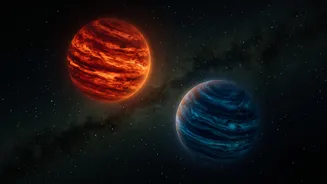
Two of the biggest puzzles in modern physics are dark energy and dark matter. Dark energy is the mysterious force thought to be causing the universe's expansion to accelerate, while dark matter is the invisible 'glue' holding galaxies together. Roman will address the dark energy question by mapping the distribution of millions of galaxies and observing distant supernovae. By measuring how the clustering of galaxies and the expansion of the universe have changed over cosmic time, scientists can test theories about what dark energy is. At the same time, Roman will conduct a massive census of exoplanets using a technique called gravitational microlensing. This method is sensitive enough to find planets down to sub-Earth masses, including 'rogue' planets that don't orbit a star. The mission is expected to find thousands of new worlds, providing crucial statistics on how common planetary systems like our own really are.
A Cosmic Partner to Hubble and Webb
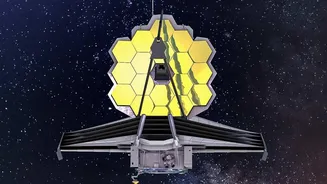
Roman is not a replacement for telescopes like Hubble or the James Webb Space Telescope (JWST), but a powerful partner. Its primary function is to be a finder scope for the entire astronomical community. By surveying billions of galaxies, Roman will identify the most interesting and unusual objects in the universe. These targets can then be studied in greater detail by Hubble, which sees a broader spectrum of light, and Webb, which can peer deeper into the infrared to see the earliest moments of the universe. Roman finds the 'what' and 'where' on a grand scale, enabling its sibling telescopes to zoom in and answer the 'why' and 'how'. In addition, Roman is testing a new coronagraph technology, an instrument designed to block the overwhelming glare from a star to directly image the planets orbiting it. This is a critical technology demonstration for future missions aimed at finding habitable worlds.