

A Thread of Protection and Love
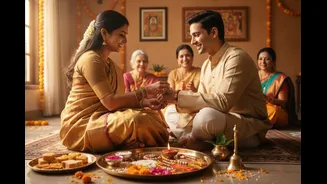
At its heart, Raksha Bandhan, which translates from Sanskrit to "the bond of protection," is a ritual that honours the relationship between siblings. A sister ties a rakhi on her brother's wrist, offering prayers for his well-being, and in return, he promises
to protect and support her. This tradition is rooted in ancient stories and mythology, from the tale of Draupadi tearing a piece of her sari to bandage Lord Krishna's wound, to Goddess Lakshmi tying a thread to King Bali. These legends establish the festival's core idea: a promise of mutual care and loyalty. For centuries, this has been the predominant image of Rakhi, a deeply personal celebration of familial duty and love.
Redefining the Promise in Modern Times
In recent years, the definition of who can participate in this ritual has beautifully expanded. The thread of Rakhi is no longer exclusively reserved for brothers. Women are tying rakhis on each other's wrists, celebrating sisterhood and mutual protection. Friends exchange rakhis to solidify bonds that feel as strong as blood ties, elevating friendships to the level of family. This modern interpretation doesn't dilute the festival's meaning; instead, it reinforces its central theme. If Rakhi is about a promise to protect, support, and cherish someone, then it naturally belongs to any relationship defined by that commitment.
The Rise of the Chosen Family
This evolution of Rakhi mirrors a broader social shift, particularly in urban India: the growing importance of the "chosen family." A chosen family is a circle of friends, mentors, or peers who provide the emotional support and sense of belonging traditionally associated with relatives. As more young people move to cities for education and careers, far from their hometowns, these non-biological kinship networks become their primary support system. They are the friends who offer help during an illness, celebrate successes, and provide a listening ear at 2 a.m. For many, these bonds, forged through shared experience and mutual care, are just as profound and reliable as those formed by birth. Rakhi has become a perfect occasion to formally acknowledge these invaluable relationships.
A More Inclusive and Relevant Tradition
Some might see this as a departure from tradition, but history shows Rakhi has always been adaptable. Historical accounts tell of Rajput queens sending rakhis to neighbouring rulers for protection and Rabindranath Tagore using the festival to promote unity between Hindus and Muslims during Bengal's partition. These instances show that the festival's spirit of creating and honouring protective bonds has always extended beyond the immediate family. Contemporary feminist interpretations also highlight the reciprocal nature of protection, noting that in some legends, the woman is the initial protector. By embracing friends and other loved ones, Rakhi becomes a more inclusive and resilient festival, reflecting the diverse ways we build family and community in the 21st century.
A Bond That Knows No Bounds
The expansion of Rakhi's meaning is perhaps most charmingly seen in the growing trend of tying rakhis to pets. This act, while lighthearted, speaks to the same core emotion: a desire to express love and a promise of care for a being that is an integral part of the family. Whether it's tied to a brother, a best friend, a sister, or even a beloved pet, the thread represents the same thing. It signifies a cherished connection and a heartfelt vow to be there for one another. It's a testament to the idea that the people who protect and support us come in many forms, and every one of those bonds is worth celebrating.