






A Heart That Bleeds Nitrogen
Pluto's most famous feature is Tombaugh Regio, a bright, heart-shaped plain splashed across its surface. The western lobe of this heart, a vast basin called Sputnik Planitia, is filled with a deep glacier of frozen nitrogen. For years, we’ve seen it as a solid,
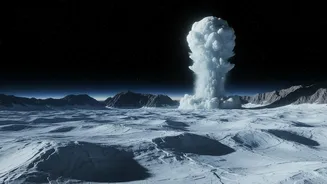
albeit slowly churning, sea of ice. But recent analysis of images from NASA's New Horizons spacecraft, which flew past the dwarf planet in 2015, has upended that view. A team led by Southwest Research Institute scientists now reports the first evidence of recently flowing liquid on Pluto. They believe that in certain areas, the nitrogen ice isn't entirely solid. Instead, it might be slushy, with liquid nitrogen seeping up from below and briefly flowing across the surface before refreezing. This find recasts Pluto from a geologically dead world into one that is surprisingly active.
The Clues in the Cracks
The evidence lies in mysterious dark streaks and patches seen along the boundaries of large, city-sized convection cells on the surface of Sputnik Planitia. These features have puzzled scientists since they were first observed. The new study suggests these dark marks are essentially stains left behind where the surface has been 'wetted' by liquid nitrogen. Researchers compared these features to similar patterns on Earth's own ice sheets, like in Greenland, where meltwater creates dark paths across the snow and ice. But on Pluto, where the atmosphere is far too cold and thin for nitrogen rain, the liquid must be coming from another source. The most likely culprit, according to computer models, is a process called basal melting.
How to Melt Ice on a Frozen World
So how can anything melt on a world where surface temperatures are unimaginably cold? The answer lies deep beneath the ice. Sputnik Planitia's nitrogen glacier is several kilometres thick. The immense pressure at the base of this massive ice sheet, possibly combined with modest heat trickling out from Pluto's rocky core, could be just enough to lower the melting point of nitrogen. This could create pockets or reservoirs of liquid nitrogen at the very bottom of the glacier. Being less dense than the solid ice above it, this liquid would be buoyant. It would push its way upwards through cracks and fissures in the ice, much like magma rising through Earth's crust, eventually reaching the surface to create the dark flows before freezing again.
A Geologically Active World
This discovery adds to a growing body of evidence that Pluto is far from being a simple, inert ice ball. Its surface shows signs of convection, where vast plains of nitrogen ice slowly churn like a planetary lava lamp. Other recent studies of New Horizons data have also identified the first confirmed landslides on Pluto, some large enough to bury a city, indicating gravity-driven processes are actively reshaping the landscape. The presence of what appears to be recent liquid activity is the most surprising find yet. It suggests Pluto may host a new kind of time-variable feature, where the surface can change periodically. As Alan Stern, principal investigator of the New Horizons mission, stated, "Pluto never stops surprising us."
What This Means for Other Icy Worlds
The idea of subsurface liquids isn't unique to Pluto. We've seen geysers erupting from Saturn's moon Enceladus and strong evidence for a subsurface ocean on Jupiter's moon Europa. But finding this process with nitrogen on a Kuiper Belt object opens up new possibilities for how icy worlds evolve. The mechanisms at play on Pluto could help explain features seen on other distant bodies, such as Neptune's moon Triton, which also shows signs of geological activity. It challenges our assumptions about what is required to power geological processes, suggesting that even in the frigid far reaches of the solar system, worlds can be dynamic and complex. This constant stream of discoveries, all from a single brief flyby over a decade ago, highlights just how much is left to learn.